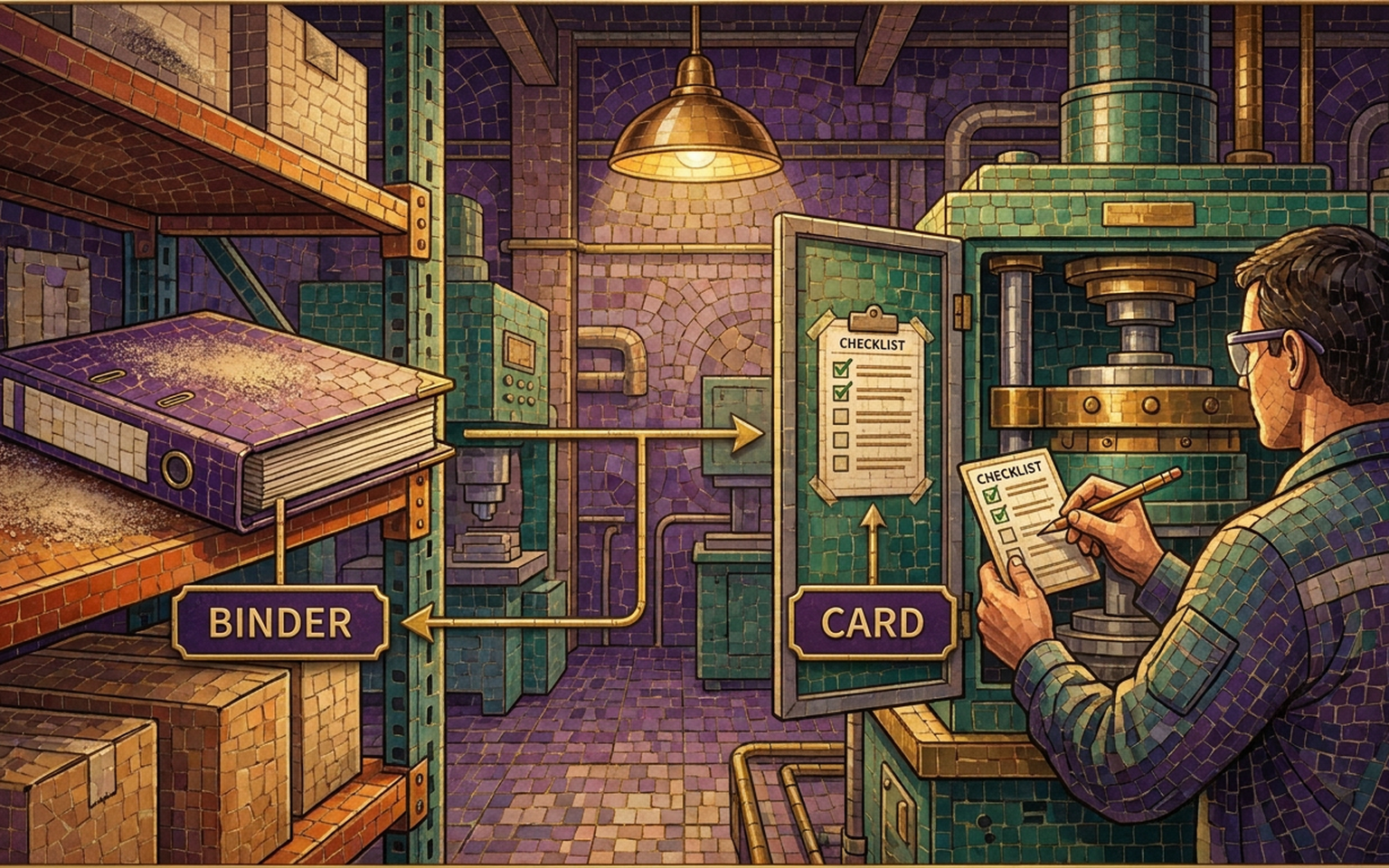
On one press line I oversaw, an operator kept a laminated card taped inside the cabinet door. Nine lines, a grease pencil, a tick beside each. The full procedure for that press ran eleven pages and lived in a binder nobody opened, and the card was the only document on the floor that people actually used.
She told me why when I asked. The procedure told her how the press worked. The card told her what she'd forget at ten past six on a short-staffed morning. Those are different jobs, and they need different documents.
When does a checklist beat a procedure?
A checklist beats a procedure when the person already knows how to do the work and the danger is skipping a step, not misunderstanding one. A procedure teaches or guides a sequence. A checklist catches omissions in work that has become familiar enough to do on autopilot.
That distinction decides almost every case. If a new hire is learning to set up a machine, hand them a procedure with the reasoning in it. If a trained operator is about to start the same machine for the four-hundredth time, hand them a list of the things that go wrong when attention drifts. If you aren't sure which situation you have, ask the person doing the work what they'd forget. The answer usually fits on a card.
For the difference between the documents themselves, what is an SOP covers where a procedure ends and a work instruction begins.
Why do checklists work in aviation and surgery?
They work because experts fail by omission under pressure, and a short list catches the omission without asking the expert to think harder. Skilled people rarely forget how to do the job. They forget one step in a job they know cold, usually when they're rushed or interrupted.
Aviation learned this the hard way. In 1935 the Boeing Model 299 crashed on a demonstration flight, and the investigation pointed to a pilot who had missed a single step on an aircraft too complicated to hold in memory. The response wasn't more training. It was a short card of pre-flight items, and that card became the ancestor of every cockpit checklist since.
Surgery followed decades later. A 2009 study of a WHO surgical safety checklist across eight hospitals reported roughly a third fewer major complications and nearly half as many deaths. The list itself was nineteen items long and took about two minutes. Nothing on it would surprise a surgeon. That was the point.
What's the difference between a read-do list and a do-confirm list?
A read-do list is performed step by step as you read it. A do-confirm list is performed from memory first, then checked against the list before moving on. Each fits a different kind of work, and picking the wrong one is the most common design mistake I see.
Use read-do when the task is rare, the order matters, or a wrong sequence causes harm. Shutting down a pressurized system is one. Restarting a line after a long outage is another. The operator reads the item, does it, and moves to the next.
Use do-confirm for routine work where the operator knows the steps and needs a safety net. A pre-shift line clearance is a good example. The operator clears the station, then runs down the list to confirm nothing was missed. A do-confirm list that someone reads aloud step by step turns into a slow procedure that people resent, which is how a good idea gets abandoned in its first month.
If the checklist belongs on the floor, how to write work instructions covers placement, type size, and reading level for someone standing at a machine.
How do you write a checklist people will actually use?
Keep it to one page and between five and nine items, make each item a single action with a yes or no answer, and test it at the station with the person who does the work. Anything longer stops being a checklist and becomes a procedure wearing a smaller font.
Start with the failure history. Pull the last six months of scrap, rework, and near misses, and put on the list only the steps that appear in those records. Everything else belongs in the procedure. A list that tries to cover everything gets skimmed, and a skimmed list is worse than none because it makes people feel covered.
Write every item as a verb and an object that someone can verify by looking. "Ensure proper lockout" fails, because nobody can tell if they've done it. "Lock and tag on the main disconnect, your name on the tag" passes. If an item can't be answered yes or no, it isn't ready.
Put it where the work happens. A checklist in a shared drive is a document. A checklist laminated at the station is a tool. Then watch someone use it for a full shift, because you'll find the item that's worded badly, the one in the wrong order, and the one nobody ever needed.
Where does a checklist hide the real steps?
A checklist hides the real steps when it stands in for understanding the work, which happens fastest with people who were never taught the procedure. A new hire can tick "torque fasteners to spec" without knowing what spec means or where to find it.
I watched this happen in an audit. Every box on a line-clearance form was signed, in the same pen, in the same slant, minutes before the audit started. The operators called it pencil-whipping, and they weren't embarrassed about it. The form had become a chore to hand in, and nobody had ever shown them what it was protecting.
The fix is partly design and partly management. Pair every checklist with the procedure behind it, so the list prompts and the procedure explains. Training materials and SOPs go further into why those two jobs should live in separate documents. Then spot-check: have a supervisor choose one item at random and ask the operator to show the evidence. Two or three checks a month keep the signatures honest.
For work where someone can get hurt, a checklist supplements the safety procedure and never replaces it. How to write safety procedures explains how the two fit together.
How do you keep a checklist from going stale?
Give it one named owner, one effective date, and a rule that any miss on the floor gets traced back to the list within the week. A checklist drifts without anyone noticing. The machine changes, the product changes, and the card in the cabinet still describes last year's setup.
Treat each failure as a question about the list. Did the item exist and get skipped, or was it never on the list? Skipped means a training or supervision problem. Missing means the list needs a line. Either way, someone should be able to answer within a few days, which means someone has to own it.
You don't need software for this. A version number, a date, and a shared folder with one official copy handle it, and document control without buying software shows how to set that up. Keep the list short enough to be reviewed in ten minutes. If it grows past nine items, split it by phase of the work or move the extras into the procedure.
If your floor has a binder nobody opens and a card somebody swears by, that's a design problem I'd like to look at. My technical writing service covers checklists, procedures, and the structure that connects them, with pricing quoted after a discovery call. You can book that call on the contact page, or read the FAQ first.
Frequently asked questions
When is a checklist better than a written procedure?
When the person already knows the work and the risk is forgetting a step. A procedure teaches the sequence to someone learning it. A checklist protects trained people doing familiar work under time pressure.
How many items should a checklist have?
Between five and nine, on a single page. Each item should be one action with a yes or no answer. If the list runs longer, split it by phase of the work or move the extra detail into the procedure.
What is the difference between a read-do and a do-confirm checklist?
On a read-do list you read each item and do it in order, which suits rare or sequence-critical tasks. On a do-confirm list you do the work from memory and then check the list, which suits routine work.
Can a checklist replace a safety procedure?
No. A checklist prompts the steps and the procedure explains the reasons behind them. For work where someone can get hurt, use both and spot-check that the checklist is being done, not just signed.