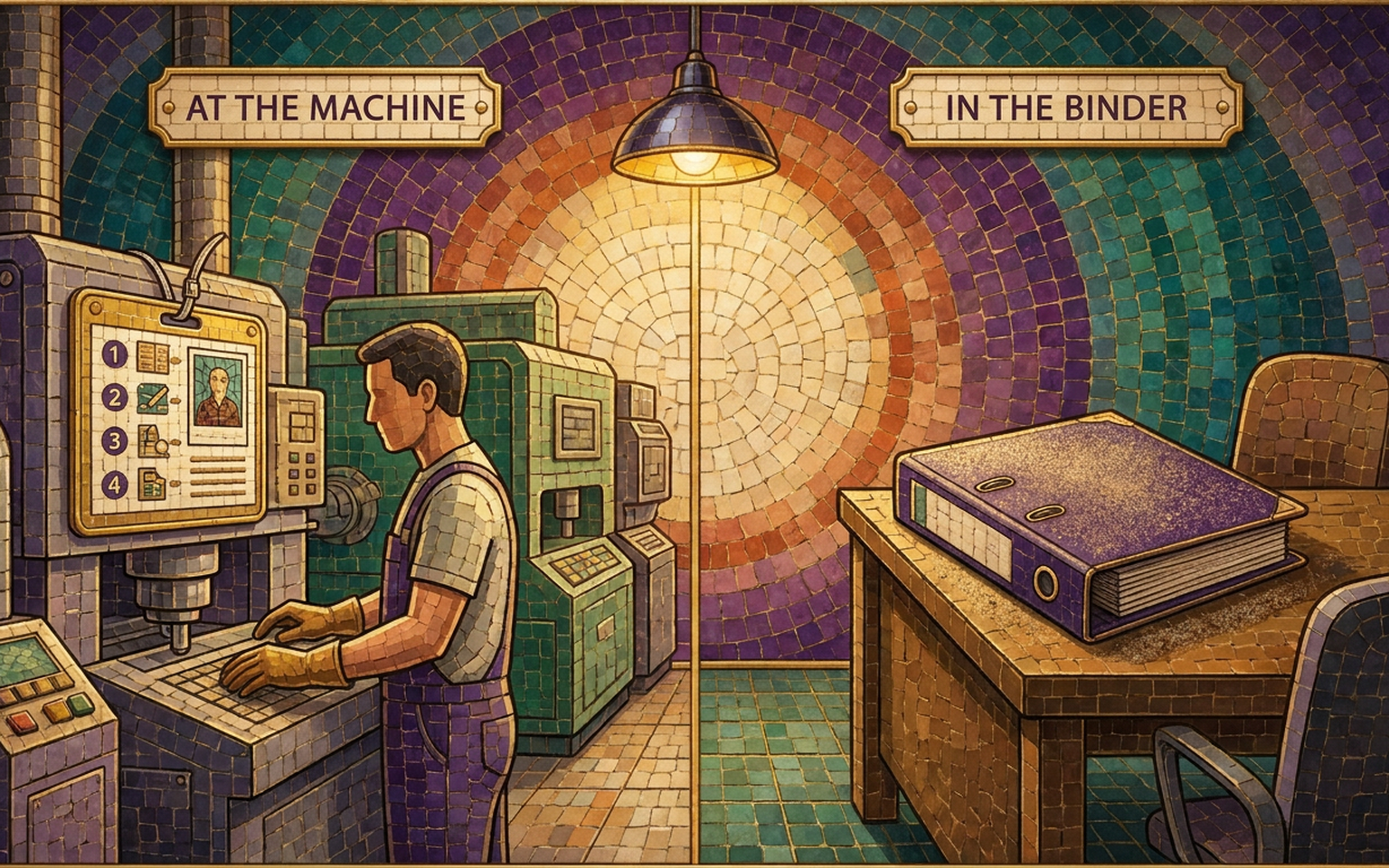
At the manufacturing company where I ran finance, the best work instruction on the floor was four photographs and about a dozen words, laminated and zip-tied to the machine it described. The worst was nine pages, carefully organized, correct in every detail, and filed in a binder in an office two hundred feet away. Same task. Only one of them ever got followed.
What makes a work instruction different from an SOP?
A work instruction tells one person how to do one task at one station, in the order their hands move. An SOP describes how a whole process runs across roles, handoffs, and departments. The procedure says incoming material gets inspected before release to production. The work instruction says how to inspect it.
Most of the documentation I'm asked to fix blurs the two. A company writes something it calls a work instruction, and it opens with a purpose statement, a scope statement, a list of referenced standards, and a revision history. Four sections before the reader learns what to pick up first. That's a procedure wearing a different title, and it'll be read once, on the day someone is trained, and never again. The distinction between procedures, work instructions, and policies matters here because each one has a different reader.
The test is who's holding the page and when. If the reader is at a desk deciding how the process should work, you're writing a procedure. If the reader is standing at a machine with gloves on, deciding what to do in the next thirty seconds, you're writing a work instruction, and almost everything that belongs in a procedure is in the way.
How long should a work instruction be, and how simply should it read?
One page for one task, readable at arm's length, written at roughly an eighth-grade level. If a task honestly needs more than a page, it's usually two tasks that got written as one, and splitting them beats shrinking the type.
The eighth-grade target has nothing to do with intelligence, and saying that plainly matters, because the objection I hear most is that it feels condescending to the crew. Reading level measures how much working memory a sentence costs, and the person reading a work instruction is spending most of theirs on the task: the noise, the timer, the part in their other hand, the supervisor waiting. Complicated phrasing raises error rates in exactly the moments where the stakes are highest, which is what the research on documentation and working memory keeps showing. I've written both versions of the same step and watched the plain one get followed correctly by people who had ignored the formal one for a year.
In practice that means numbered steps holding one action each. It means "torque to 45 foot-pounds" instead of "ensure that appropriate torque specifications are achieved." The verb comes first. And it means cutting every sentence that explains why, because why belongs in training, where someone has time to absorb it.
Where does a work instruction actually belong?
At the point of work, within arm's reach of the task, in a physical form that survives the environment it lives in. A work instruction filed in an office binder is a document that exists without being a document anyone uses.
This sounds obvious and it's still the most common failure I find. The writing is fine. The placement makes it useless. Nobody walks two hundred feet, takes off gloves, opens a binder, reads step four, walks back, and does step four. They do what they remember, and what they remember drifts.
Laminate it. Mount it where the operator's eyes already go. If the station is wet or oily, laminate stops being optional, and if you've gone to tablets, check the screen at the angle and the light level someone will actually read it at rather than at your desk. One plant I worked with mounted beautiful screens above every cell and discovered in July that afternoon sun off the skylights made four of them unreadable between two and four o'clock.
A posted copy still needs document control: a revision number and an effective date on the page itself, or in eighteen months nobody can tell whether the laminated sheet is current. Posted copies are where version control usually breaks first, because updating the master file feels like finishing the job.
When should a photograph replace a sentence?
Use an image whenever the reader has to recognize something rather than decide something. Correct versus incorrect seating, the right cable in a bundle of six, the color a weld should be. Eyes are faster than words for recognition, and more reliable.
The pairing that works best is one photo per step where recognition matters, shot from the operator's own viewpoint instead of straight on from a tripod. A photo taken from where the reader's head actually is gets matched against reality in about a second. A photo taken from the flattering angle makes them translate first.
Two cautions, both learned expensively. Photographs go stale faster than text, because equipment changes and a sentence describing a fixture still reads true while a picture of last year's fixture obviously doesn't. Whoever owns the document owns re-shooting the photos. Second, an image of the wrong way has to be marked unmistakably, with a red X across the frame, not a caption underneath it. Someone scanning fast will copy what they see and never reach the caption.
Why write these at all if everyone already knows the job?
Because the instruction isn't written for the person who knows. It exists for the second shift, the temp in week two, the operator covering a station that isn't theirs, and the morning your most experienced person retires or calls in sick during a rush.
If your crew is stable, experienced, and never absent, work instructions buy you very little day to day. What they buy is the ability to survive a change in any of those three conditions without a quality event, which is the same reason institutional knowledge is worth capturing before the person holding it leaves.
There's a second return that owners tend to notice faster. The instruction is the only place a disagreement gets settled. When two experienced people run the same task differently and both are confident, a written instruction forces somebody to decide which way is right. That decision is usually worth more than the document it goes into.
How do you know a work instruction is actually being used?
Go look at it. A used instruction is dirty, marked, sometimes corrected in pen. A clean laminated page that's hung in the same spot for two years is a page nobody reads, and the pen marks are the most useful feedback you'll ever get for free.
The other test takes ten minutes. Hand the instruction to someone competent who doesn't normally run that station, ask them to do the task from the page alone, and watch without saying anything. Every place they hesitate is a defect in the writing. Every question they ask is a step you assumed was obvious. I've never run that test without finding at least three.
If you're standing in front of a stack of work instructions that are already wrong, don't start over. Sort them by what a mistake costs: safety first, then quality escapes that reach a customer, then everything else, and rewrite in that order. Most companies have a handful of instructions doing real work and a great many nobody would miss, and telling those apart takes a walk through the plant rather than a project plan.
That walk is most of what my technical writing work actually is: standing at the station, watching the task, and writing something a person can follow while they're doing it. Questions clients ask before we start are answered on the FAQ, and a short discovery call is the fastest way to find out whether what you have is worth fixing or worth replacing.
Frequently asked questions
What is the difference between a work instruction and an SOP?
An SOP describes how a process runs across roles, handoffs, and departments. A work instruction tells one person how to perform one task at one station, in the order the work happens. The SOP says material gets inspected before release; the work instruction says how to inspect it.
How long should a work instruction be?
One page for one task. If a task genuinely needs more than a page, it is usually two tasks written as one, and splitting them works better than reducing the type size to fit.
What reading level should work instructions be written at?
Roughly an eighth-grade level. This is not about the reader's intelligence. Reading level measures how much working memory a sentence costs, and an operator is already spending most of theirs on the task, the noise, and the timer. Complicated phrasing raises error rates where the stakes are highest.
Should work instructions include photographs?
Yes, wherever the reader has to recognize something rather than decide something: correct versus incorrect seating, the right cable in a bundle, the color a weld should be. Shoot from the operator's viewpoint, mark any wrong-way image with a large X across the frame, and re-shoot the photos whenever the equipment changes.