The lockout procedure at the plant where I was CFO ran four pages, and every operator on the floor had signed it. A maintenance tech told me once, with no embarrassment at all, that he had never read it. He signed it the way you sign for a package. The paperwork was perfect, and the behavior it was supposed to change hadn't moved an inch.
What makes a safety procedure different from any other procedure?
A safety procedure has to work at the moment of risk, when the reader is tired, rushed, or sure they already know the answer. An ordinary SOP can be read at a desk and forgotten. A safety procedure is read, if at all, a few feet from something that can hurt someone.
That changes who you're writing for. (For the general case, see what an SOP is and why most fail.) Compliance-shaped safety writing is addressed to the auditor: complete, cross-referenced, dense with the language of the regulation. In the United States, OSHA's lockout/tagout standard requires written energy control procedures, so the document has to exist. But the inspector reads it once a year. The operator meets it every shift, or doesn't meet it at all. Write for the second reader and the first one is usually satisfied anyway.
Why do people sign safety procedures and then ignore them?
Because signing takes ten seconds and following takes judgment, effort, and time. People skip a step when it seems pointless, when it slows the job, or when the document is so long that finding the step costs more than the risk feels like it's worth. The fix is a better document, not a stricter memo.
I've watched this happen from the finance side, where the cost of a shortcut eventually lands on a spreadsheet. The crew that cut corners on a guarding step wasn't careless. The step was buried on page three of a document written in passive voice, and the machine was two hundred feet from the binder. Every person on that floor had a rational reason to skip it. Punishing them for it would have changed nothing about the document that made skipping the easy path.
The objection I hear most is that people should simply read what they're given. They should. They won't, and a procedure that depends on everyone behaving ideally isn't a control. It's a hope with a signature line. How documentation lands under pressure is a working-memory problem, and the reader who's already juggling the noise, the timer, and a part in one hand has very little left over for paragraph two.
Where should a safety procedure live so it gets used?
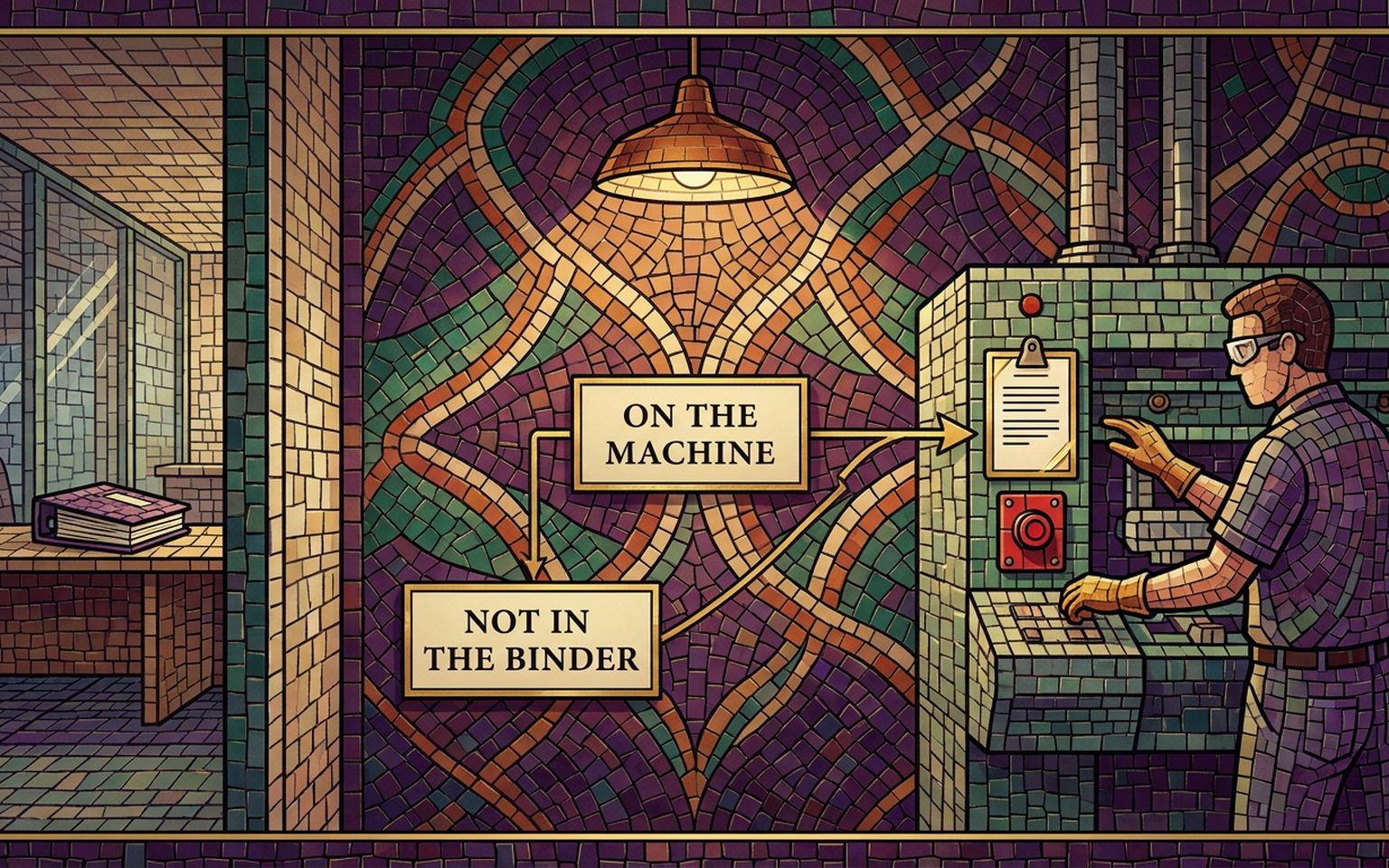
At the point of risk, within arm's reach, sized so it can be read in the time it takes to decide whether to skip it. A one-page card mounted on the machine will be followed. The same content in a binder in an office won't be opened.
Placement does more than wording. At the plant, the single most effective change we made to lockout wasn't rewriting anything. It was taking each machine's steps, cutting them to one page, and mounting that page on the machine itself, with the lockout points marked in the same color used on the page. The document and the hazard finally sat in the same place. The long procedure stayed in the binder for the auditor, where it belonged. If that split sounds familiar, it's the same one behind work instructions written for the floor: the reference version and the doing version are two different documents.
How do you write a step so nobody has to interpret it?
One action per step, in the order the hands move, starting with a verb, naming the exact object and the exact state. "Verify the machine is safe" leaves the decision to the reader. "Press the stop button, then confirm the spindle has stopped turning" leaves nothing to decide.
Vague safety language is the most common defect I find. "Ensure proper guarding is in place." "Take appropriate precautions." "Verify zero energy state." Each one is correct and none of them can be followed by someone who doesn't already know what proper, appropriate, or zero means. The writer knew. The writer was usually the safety lead, and the words felt precise because they carried that person's years of context.
Put the check in the step. If the step is to isolate power, the next line says what the reader will see or feel when it worked: the light is off, the gauge reads zero, the try-start doesn't start. A reader who can confirm each step for themselves doesn't need to trust the procedure. They can test it, and that's what makes people believe it.
Should a safety procedure explain why?
Yes, once, briefly, and in the right place. A single sentence naming the consequence next to the step people most often skip does more than a page of rationale at the front of the document. Put the reasoning where the temptation is.
This is where safety writing and training material pull in opposite directions. Training should carry the full story, including the incident that produced the rule. The card on the machine can't. What it can carry is one line beside the step that gets skipped: "Stored pressure can move this arm after power is off." Someone who has read that line at the moment they were about to skip the bleed-down step remembers it differently than someone who heard it in orientation eight months ago.
If you're rewriting an existing procedure, find the two or three steps people skip. Ask the crew why, and write that answer into the document. The cause is usually a step that doesn't work as written, and that's a writing problem you can fix.
One more failure mode deserves a sentence, because I've watched it undo good work. A company rewrites its safety cards, mounts them, and never tells the people who were skipping steps what changed or why. The crew assumes it's the same paperwork in a new font. Walk the floor with the new card, hand it to the person who used to skip the step, and ask them to try it. Ten minutes of that beats an all-hands memo, and it shows you the last defect before the auditor does.
How do you know whether anyone follows it?
Watch the work, then watch it again. Have someone who wasn't involved in writing the procedure follow it on the real machine, step by step, and note every place they hesitate or improvise. Hesitation is the defect report. The signature sheet tells you almost nothing.
I'd rather see a procedure tested by a new hire and a skeptical veteran than reviewed by five managers. The new hire shows you where the document assumes knowledge. The veteran shows you which steps are theater. Both find the same thing, which is that the page and the work disagree somewhere, and it is better to learn that on a Tuesday than after an incident.
Then keep the document alive. A safety card that describes last year's machine teaches everyone that the cards are decorative, and that lesson spreads faster than any training you'll run. Assign each card an owner and a review date, and treat a change to the equipment as a change to the card. If you'd like a second set of eyes on how your procedures would survive that kind of test, see how I approach technical writing, read the FAQ, or book a discovery call. Pricing is quoted after a discovery call, once I've seen what you have.
Safety documentation that changes behavior is short, physical, placed where the risk is, and tested by people who'll actually use it. Everything else is filing.
Frequently asked questions
What should a safety procedure include?
The exact steps in the order the work happens, written one action per step, with a check the reader can confirm for themselves and a short reason beside any step people tend to skip. Background, scope, and regulatory references belong in a longer reference version kept separate from the version used at the machine.
Why don't employees follow written safety procedures?
Usually because the document is too long, too vague, or too far from the equipment, so following it costs more effort than skipping it. A signature shows that someone received the procedure, not that it fits the work. Testing the procedure with the people who do the task shows where it breaks.
Where should safety procedures be posted?
At the point of risk, within arm's reach of the equipment, on a single page that can be read in the time it takes to decide whether to skip a step. The longer reference version can stay in a binder or document system for auditors and training.
Does OSHA require written safety procedures?
For certain hazards, yes. The lockout/tagout standard, for example, requires written energy control procedures. Requirements vary by industry and hazard, so confirm what applies to your operation with your safety lead or an occupational safety professional.