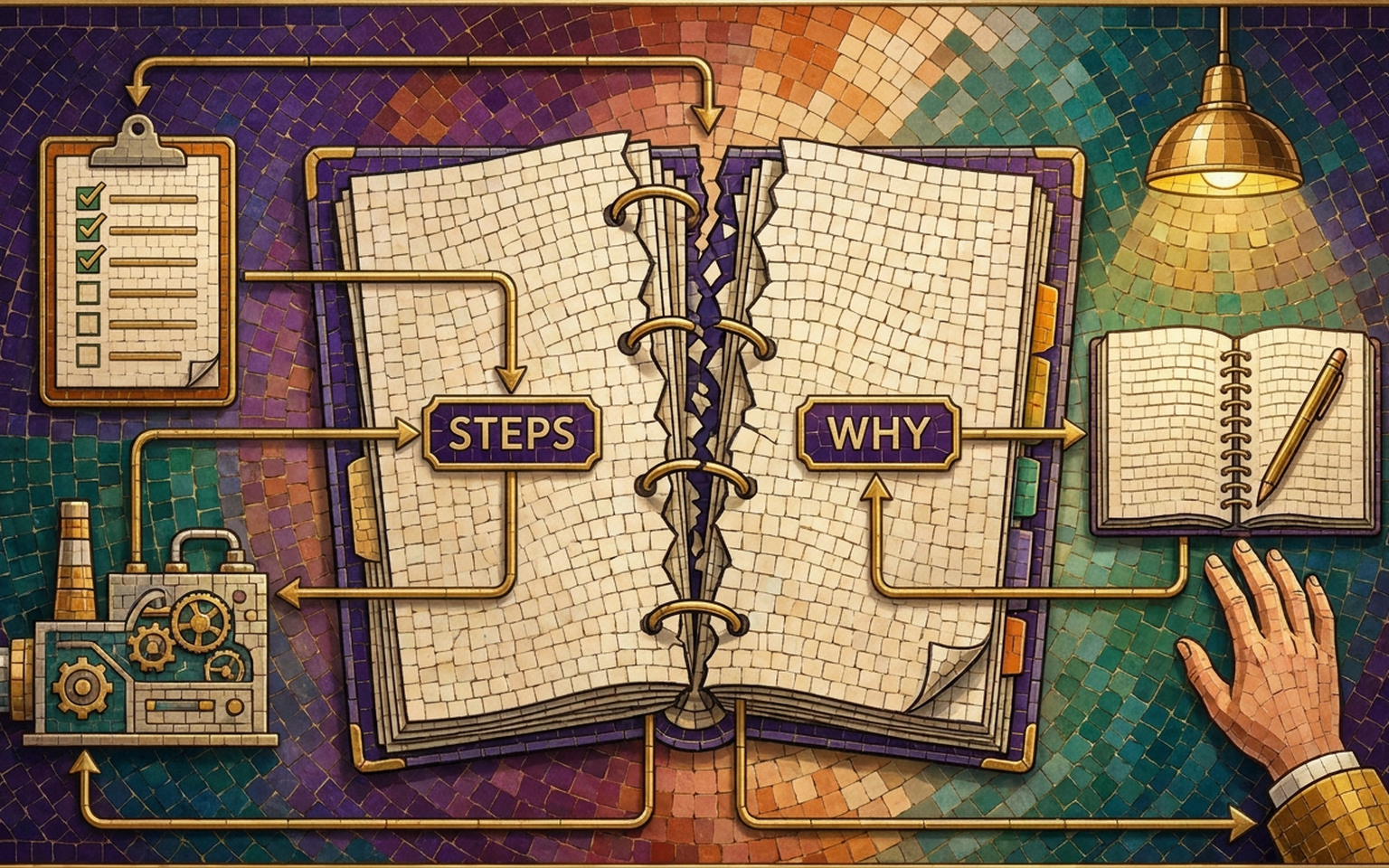
For two years, one binder at the manufacturing company where I was CFO did double duty as new-hire training and our ISO procedure library. New hires read it during onboarding and forgot half of it by their second shift; the auditor read the same pages that spring and flagged three sections that had drifted off the standard entirely. One document, two jobs, and neither failure surfaced until the audit did.
What's the real difference between a procedure and a training document?
A procedure is a reference someone consults while performing a task they've already learned. A training document teaches that task for the first time, with the why, the context, and room to get it wrong safely along the way. Confusing the two produces something nobody can use correctly: too thin to teach anyone and too padded to reference under pressure.
The confusion starts from a reasonable instinct. If you're already writing down how a task works, why not fold in everything a new person needs to know while you're at it? By the time training becomes its own problem, most companies I work with already have an SOP on file, so it's natural to reach for that document and add to it rather than start a second one. What gets added is context: the reason the standard exists, the history behind a change, the mistake that prompted a step in the first place. None of that belongs in a document someone is scanning mid-task to confirm a torque spec, and none of it survives being cut once the document has to double as a quick reference.
Why do companies keep building one document to cover both jobs?
Mostly cost and calendar. Two documents feel like twice the writing, and a smaller operation often has one person handling documentation instead of a training function and a quality function working separately. The shortcut looks efficient right up until an audit or a new hire needs something fast mid-shift and can't find it in eleven pages of context.
I inherited exactly this setup at the plant. One writer, one deadline, one document that had to satisfy the auditor and the new hire at once, because there wasn't budget for two projects that looked, on paper, like they covered the same ground. The document that resulted read fine in isolation. It failed the moment two different readers needed two different things from it on the same afternoon: a new operator needing the reasoning behind a step, and a floor lead needing step four with nothing else in the way. Work instructions fail for a version of this same reason when they carry procedure-level detail instead of the one task in front of the reader.
The objection I hear most when I recommend splitting a hybrid document is that two documents mean twice the maintenance. In practice, it's the opposite. A procedure that only holds steps changes when the process changes, which is rare. A training document that holds context changes even less, since context ages slower than method. What actually doubles under the old approach is the editing burden: every small process tweak means finding and fixing it inside pages of unrelated explanation, which is how procedures end up years out of date in companies that swear they update them constantly.
What happens when a procedure tries to double as training?
It gets long, and length is the tell. A procedure written to also teach accumulates background, rationale, and asides until the thing someone needs during a task is buried three paragraphs into the thing someone needed during orientation. Readers stop trusting it to be fast, so they stop opening it, and the knowledge that was supposed to live in the document moves back into people's heads instead.
This is the failure mode I watch for first when I'm brought in to fix an existing library: documents that grew rather than were written, each addition reasonable on its own, the sum unusable. A department that's honest with itself can usually tell within a year. The tell isn't complaints. It's silence: nobody refers to the document anymore, they just ask the person next to them, and the institutional knowledge that should have transferred into the page stays exactly where it started, in one person's head, one retirement away from leaving.
I watched a maintenance team stop opening a forty-page "procedure" entirely and start keeping a shared notebook by the breaker panel instead, handwritten, with steps nobody had verified in two years. The real, approved procedure was more accurate. Nobody trusted it to be fast enough to check mid-repair, so the notebook won by default, and the company had no idea its official documentation had been replaced until I asked to see what people actually used.
What should a training document actually contain?
Context, sequence, and permission to practice. Why the task matters, what happens if it's done wrong, the order concepts build in, and worked examples a trainee can try under supervision before doing it alone. A training document is allowed to be long, because a trainee has the time and the attention that someone mid-shift does not.
When I write training material now, I build it around one question: what does someone need to understand before the procedure will make sense to them? For a quality-inspection role, that's usually why the specification exists, what a defect actually costs the company downstream, and two or three examples of borderline calls with the reasoning spelled out. None of that belongs in the inspection procedure itself. The procedure just needs the steps. Training earns the space to explain; the procedure has to earn its keep in thirty seconds or less.
What should the SOP contain instead, once training is its own document?
The steps, the sequence, the standard, and nothing that requires the reader to stop and think. Once training carries the why, the procedure gets to be short again, and short is what makes it get used. This is usually the moment a client realizes their old hybrid document was really two failed drafts stapled together.
Splitting the two documents almost always shrinks the procedure by half or more, and that's the point rather than a loss. A good SOP reads like a checklist with the judgment already built in: the decisions were made when it was written, not when it's being followed. If a reader has to stop and reason through a step, the reasoning was supposed to happen in training, and its absence in the procedure is a bug, not an oversight.
How do you split an existing hybrid document without starting from scratch?
Read through it once and mark every sentence as either "step" or "context." The step sentences become the new procedure, roughly in the order they already appear. The context sentences become the outline of a training module. Most of the rewriting is sorting, not writing new material, which is why this project takes days, not months.
I've done this split on documents that had sat untouched for three years because nobody wanted to be the one to rebuild them from nothing. Rebuilding wasn't necessary in a single one of those cases. The content was already there; it just needed two homes instead of one, and a decision about which reader got which page.
If you inherited a hybrid document and didn't design it to work this way on purpose, you haven't done anything unusual. Almost every documentation library I'm brought in to fix grew the same way: one well-meant addition at a time, until the well-meant additions outgrew what either reader could actually use it for. That's not a writing failure on your part. It's a sorting job waiting for someone to do it.
If your current documentation is carrying both jobs and neither one well, that's the conversation worth having before you write another word. I cover this kind of split as part of technical writing work, and a discovery call is where we figure out how much of yours is salvageable versus how much needs a rewrite. If you have questions before then, the FAQ page covers the ones I hear most often.
Frequently asked questions
What's the difference between a training document and an SOP?
An SOP is a reference someone checks while performing a task they already know. A training document teaches that task for the first time, with the reasoning and worked examples a new employee needs before performing it independently.
Can one document serve as both training material and a standard operating procedure?
It rarely works well. A document detailed enough to train someone new is too long to serve as a quick reference during a task, and a document short enough to reference quickly usually skips the context a new employee needs to actually learn the work.
How long should a training document be compared to an SOP?
Training documents can run much longer than SOPs because a trainee has time to read and practice. SOPs should be short enough to check in under a minute, since the person using one is already mid-task.
What's the fastest way to split an existing document that tries to do both jobs?
Read through it once and mark each sentence as either a step or context. The step sentences become the procedure. The context sentences become the outline for a training module. Most companies are surprised how little new writing the split actually requires.