Two departments once approved the same purchase request on the same morning, each certain the signature was theirs alone to give. The form was ten years old. Nobody in either office could say who had started the practice, and both had written procedures that described it as their own.
We found this out in the first hour of a mapping session, before a single word of procedure existed. That's the argument for mapping first, and it's the one I make to every client who wants to skip straight to writing.
Why map a process before you write the procedure?
Map first, because a procedure written from memory records what people believe happens, and a map records what does. The two accounts differ more often than anyone expects, and the gap is where the delay, the rework, and the expense live.
When I ran finance for a manufacturer, I wrote procedures from interviews, one person at a time. They read well. They were also wrong in the places that mattered, because each person described their own step accurately and the handoffs vaguely. Nobody owns a handoff, so nobody describes it truthfully. A map puts every handoff on one page where the whole room can see it. If you've read how to document a process before you write it down, mapping is the working session that article leads up to.
What does a process map actually show?
A process map shows who does each step, in what order, what they pass along, and where the work waits. That's all it needs to show. It isn't a flowchart built for a conference slide, and it doesn't need software.
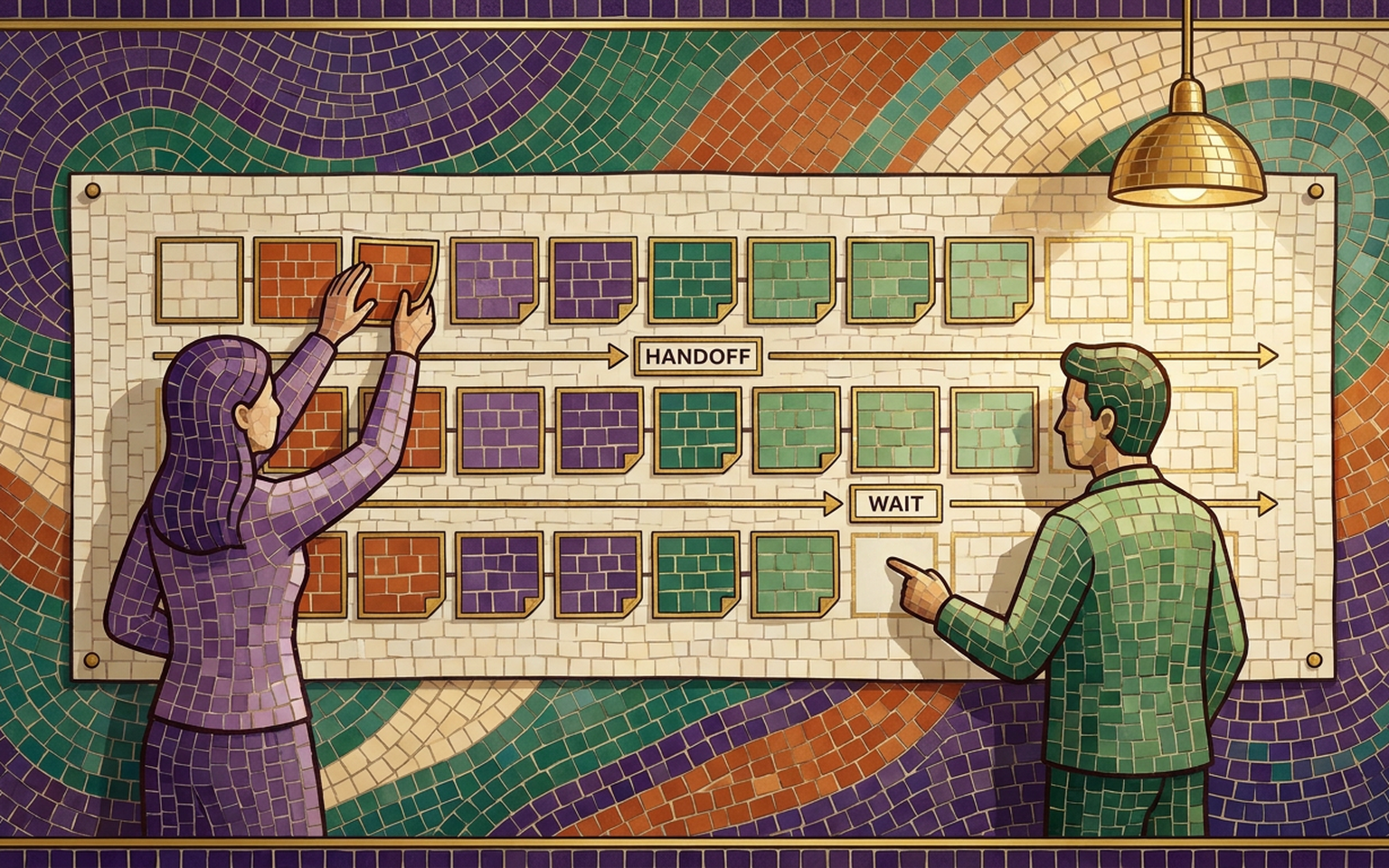
Four things go on the page: the trigger that starts the work, each action in sequence, each decision with its yes and no branches, and the output that ends it. Then add the two things most maps leave out. Mark every handoff, and mark every place where work sits waiting for someone. The waiting is usually where the days go. A purchase request that takes eleven days often holds forty minutes of actual work.
Use sticky notes on a long sheet of butcher paper, or index cards on a wall. Paper beats a screen because people will move a note when they're corrected, and they won't bother to fix a diagram someone else drew.
How do you run a mapping session?
Put the people who do the work in one room for ninety minutes, start from the trigger, and walk the process forward one step at a time while someone else writes. Don't invite only the managers. Managers describe the process as designed. The person who does it on a Tuesday describes the process as it runs.
Ask the same two questions at every step: what happens next, and what do you need before you can start? The second question surfaces the missing inputs, the approvals that stall, and the spreadsheet only one person knows how to open. Keep a separate sheet for problems and don't solve them in the room. The moment people start arguing about the fix, the mapping stops.
Walk one real case, not the general one. Pull an actual order or request from last month and follow it through. People will tell you the process has five steps. The real order took nine, and three of them involved a phone call.
Expect some resistance at the first session. Someone will worry the map makes them look bad. The honest answer is that the map describes the work, not the worker, and every process I've seen fixed by blaming a person was back to its old shape within a year.
What do swim lanes show that a list of steps can't?
Swim lanes show ownership, because each row belongs to one role and every time the work crosses a line, a handoff happens. A numbered list hides who does what. Lanes make the crossings countable.
Draw one horizontal lane per role or department and place each step in the lane of whoever performs it. Then count the crossings. A process that crosses between lanes eleven times has eleven chances to lose the work, and you'll usually find that three of those crossings exist only because of a rule nobody remembers adopting. Two steps with the same label in two different lanes is the signature of the purchase form I started with.
I've also seen the reverse: a lane with nothing in it, where a role is named in the old procedure but no longer exists. The work it once did still has to happen, so someone absorbs it, unpaid and unrecorded. A map shows that gap in thirty seconds. Why your best employee writes the worst documentation explains why that absorbed work never makes it into writing.
What should you do with the problems the map turns up?
Sort them before you write anything: fix the cheap ones now, settle the ones that need a decision, and document the rest as they are. Writing a procedure for a broken process only makes the break permanent and official.
Duplicate approvals, unused steps, and handoffs with no owner can usually be settled in a week by the people in the room. Others need someone with authority: who signs, what the limit is, which department keeps the record. Put those on one list with a name and a date beside each, and don't write that part of the procedure until the decision exists. What is process design covers why the redesign and the writing belong in the same project, and why splitting them is how companies end up with two sets of documents.
Some problems you'll leave alone on purpose. A clumsy step that happens twice a year costs less than the meeting to change it. Write it down accurately and move on.
How do you turn the map into a procedure?
Write one procedure for each stretch of the map that a single person can carry out, and keep the map as the reference that ties them together. The map is the picture, the procedures are the instructions, and neither replaces the other.
Walk the map left to right and cut it wherever the work changes hands. Each piece becomes a short document with one owner, written for the person doing that piece. How to write an SOP a new hire can actually follow covers the writing itself, and how to write work instructions covers the floor-level detail. Put the map at the front of the set, with a version and a date, so every reader can see where their piece sits in the whole.
Mapping adds time at the start and takes it out of everything after. On a small project the session and the cleanup list add about a week, and the procedures that follow need far fewer revision rounds because the arguments already happened. For a sense of what the whole project costs, what it costs to document your processes gives honest market ranges.
If you have a process nobody can describe the same way twice, that's where I'd start. My technical writing service includes the mapping session, the cleanup list, and the procedures that follow, quoted after a discovery call. You can book the call on the contact page, or read the FAQ first.
Frequently asked questions
Why map a process before writing the procedure?
A procedure written from memory records what people believe happens, while a map records what actually happens. The gaps between the two, mostly at handoffs between departments, are where delay, rework and cost hide.
Who should be in a process mapping session?
The people who actually do the work, plus one person to write. Managers describe the process as designed, and the operators and clerks describe it as it runs. Ninety minutes with a real case from last month is usually enough for a first pass.
Do I need special software to map a process?
No. Sticky notes on butcher paper or index cards on a wall work well, because people will move a note when corrected. Software can come later, once the map is accurate and agreed.
What is a swim lane diagram?
A process map with one horizontal lane per role or department, where each step sits in the lane of whoever performs it. Every time the work crosses a lane line is a handoff, which makes lost work and unclear ownership easy to see.