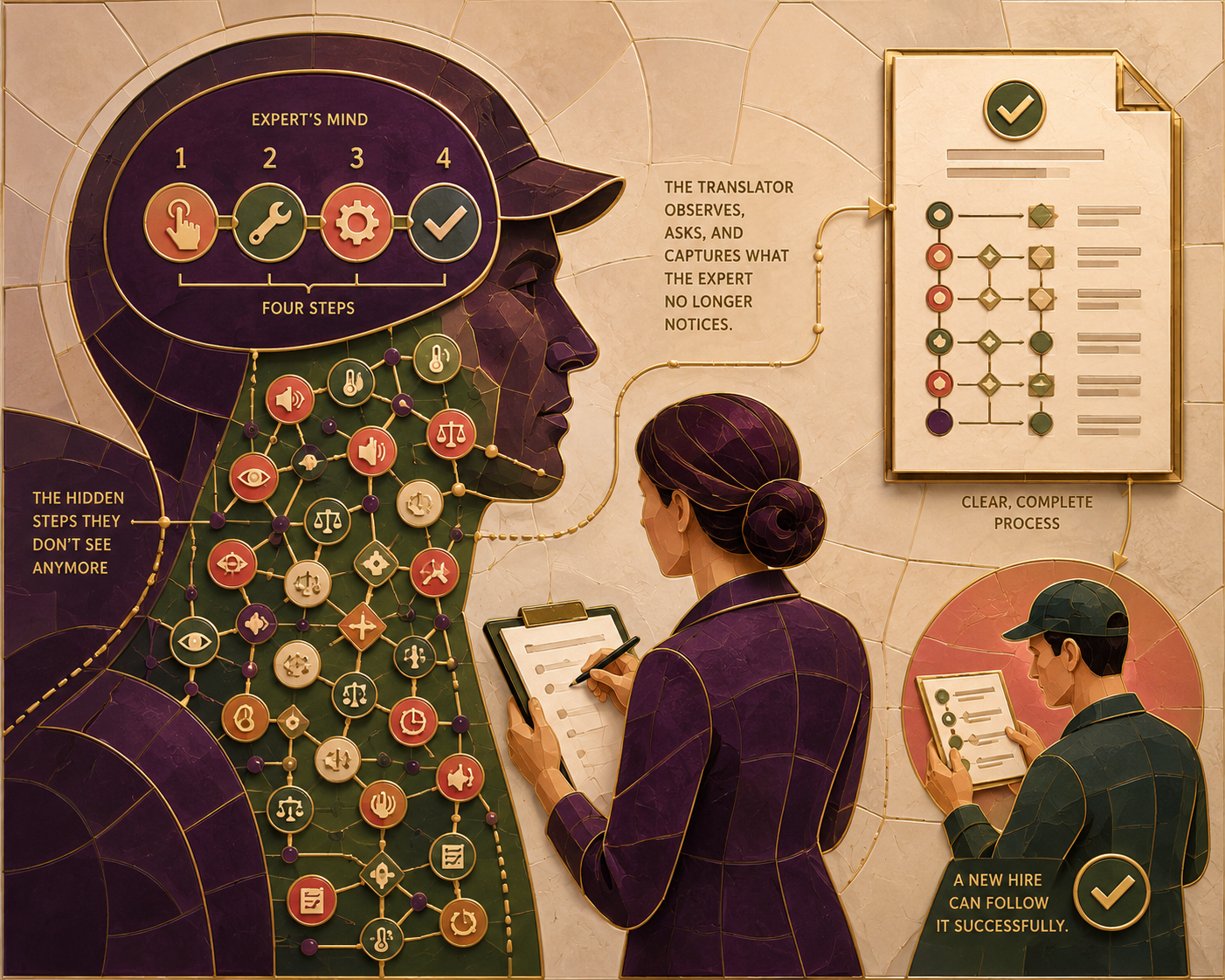
The person who knows a process best is usually the worst person to write it down. That's not a criticism of them. It's a predictable consequence of knowing something well, and it has a name.
Why does your best employee write the worst documentation?
Expertise compresses. After enough repetitions, a twelve-step task collapses into one motion in the expert's mind, and the steps that got folded away are precisely the ones a new hire needs. Nothing is being withheld. The gaps are invisible from where the expert stands.
I spent years as the chief financial officer of a manufacturing company, and the procedures that came back from our most capable operators were always the shortest. One of them wrote a changeover as four steps. It took him eleven minutes, and it took a new hire two hours, because the four steps he wrote were the four he still had to think about. The other thirty had become reflex, which his hands remembered and his description did not.
What is the curse of knowledge?
The curse of knowledge is the difficulty of imagining not knowing something once you know it. Once information is in your head, you cannot reliably model a mind without it, so you write for a reader who already understands, which is to say you write for yourself.
The research on this is unkind. In a well-known study, people asked to tap the rhythm of a familiar song predicted that half their listeners would name it. About one in forty did. The tapper hears the melody. The listener hears knocking. Every expert writing a procedure is tapping, and every new hire is listening to knocking.
What does an expert leave out of a procedure?
Not the hard parts. The automatic ones. The omissions are consistent enough that you can go looking for them by name:
- The decision made before step one, the one that determines which procedure applies at all
- Conditions read without conscious thought: sound, resistance, temperature, color, smell
- What a correct result looks like, since the expert has never watched anyone fail to recognize it
- What to do when a step does not work, which is exactly where a new person stops
- The reason a step exists, which is the first thing dropped when someone is writing in a hurry
That last one matters more than it looks. A step without a reason is the first step quietly abandoned when the shift runs late, and no one can tell you afterward whether it mattered.
Why doesn't asking for more detail fix it?
Because the expert cannot locate the gaps, so more detail lands where detail already was. You ask for depth, and you get another paragraph on the part they still find interesting. The document gets longer and no easier to follow.
This is how binders reach ninety pages while training time stays flat. Volume is not the same as clarity, and adding words to a document that fails at step three simply moves the failure later. When an existing manual has already gone that way, the repair is usually structural rather than additive, which is a different job from writing more. That kind of rescue is editing work.
What does a translator do that the expert cannot?
A translator is useful precisely because she doesn't know the job. She notices the step that was skipped in the telling, asks why it happened, and gets the answer the expert would never have thought to say out loud.
The questions that produce the most are the ones an insider is too experienced to ask. How do you know that's finished? What tells you it went wrong? What happens if you do this out of order? Show me the last time it didn't work. An expert answers those readily. They almost never volunteer the answers unprompted, because from inside the work, the answers are too obvious to be worth saying.
How do you get the knowledge out of an expert's head?
Watch first, ask second, test on a novice. Observation surfaces what interviews miss, because the body knows steps the sentence forgets. Then the questions fill in judgment. Then a person who has never done the task follows the draft while you say nothing at all.
That silent test is the whole method. Every hesitation is a defect in the document, not in the reader. Write down where they paused, fix those places, and run it again. Two rounds of that will teach you more about your process than a month of meetings about it. It's also where technical writing turns into process design, because the questions that expose a gap in the document often expose a gap in the process underneath it.
What should you do with your best employee instead?
Make them the reviewer, not the author. Their judgment is the thing you actually need from them, and judgment is easier to apply to a draft than to a blank page. Someone else writes it, the expert marks what is wrong, and the correction is specific instead of imaginary.
That trade also protects the asset. The people who hold the most process knowledge are usually the busiest, and asking them to write for six hours costs you the work they were doing instead. An hour of their review is worth more than a day of their drafting. Common questions are answered on the FAQ, and a discovery call is the fastest way to find out whether your documentation problem is a writing problem or a translation one.
Frequently asked questions
Why do experts write bad documentation?
Expertise compresses. After enough repetitions a long task becomes a single motion in the expert's mind, and the steps that got folded away are the ones a new hire needs. The expert is not withholding anything. The gaps are invisible from where they stand.
What is the curse of knowledge?
The curse of knowledge is the difficulty of imagining not knowing something once you know it. Because you cannot reliably model a mind that lacks the information, you write for a reader who already understands the process, which produces a document only you can follow.
What do experts usually leave out of a procedure?
Not the difficult parts, the automatic ones. The decision made before step one, the conditions they read without thinking, what a correct result looks like, what to do when a step fails, and the reason each step exists.
How do you capture knowledge from an expert?
Watch the work first, then interview for the judgment behind it, then hand the draft to someone who has never done the task and say nothing while they follow it. Every hesitation marks a defect in the document. Fix those places and run the test again.