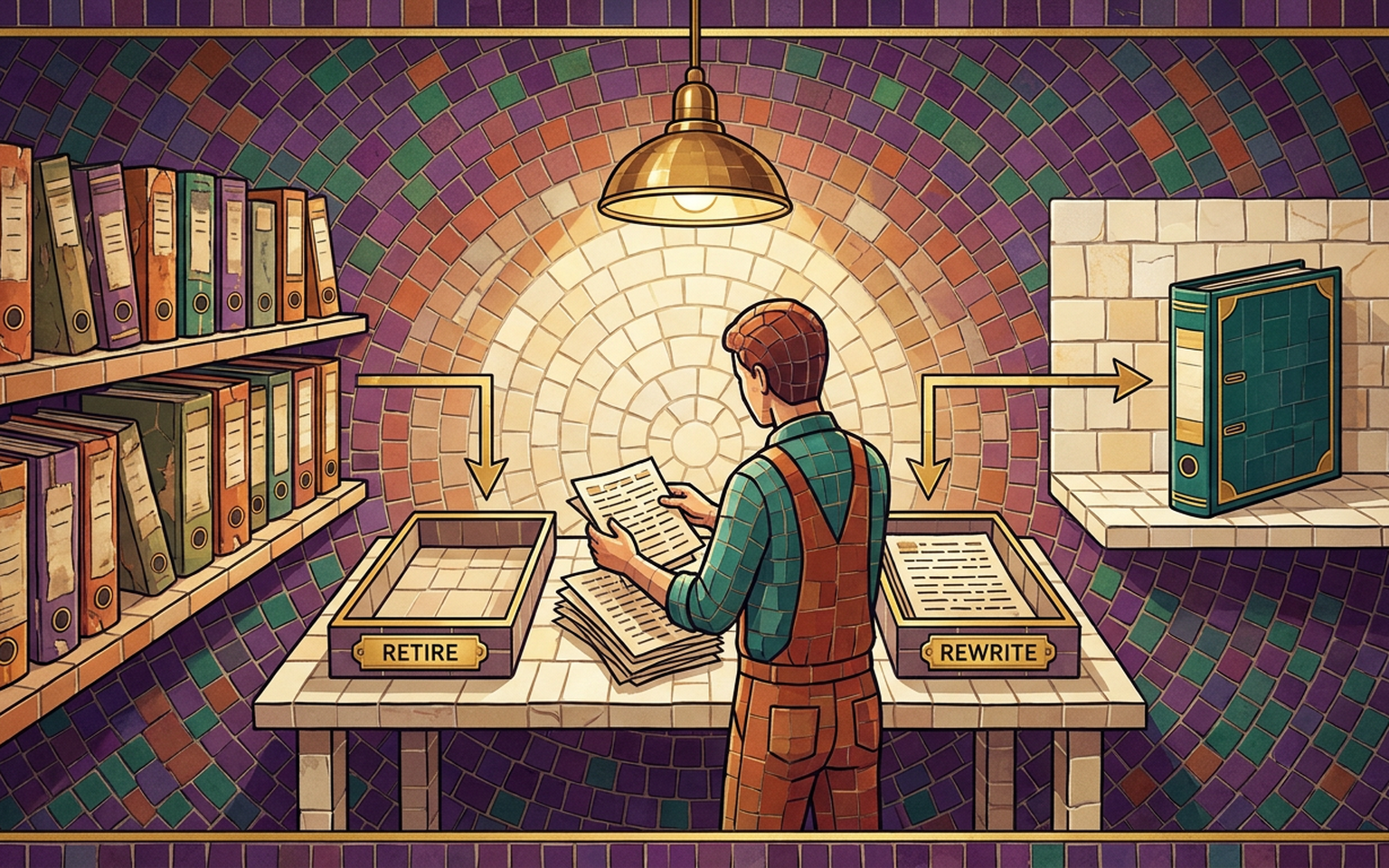
The year I became CFO, I inherited a shelf of binders: two hundred and some procedures, a good number of them signed by people who'd long since left. Nobody wanted to open them. Nobody wanted to throw them out either, and that standoff is how most companies end up living with the problem for years.
You don't have to rewrite all of it. You have to sort it, in the right order, and most of the work gets smaller once you do.
What do you do with 200 outdated SOPs?
Sort them into three piles before you write anything: retire, rewrite, and leave alone after a check. Rank by risk and daily use, not by age or department. The sort takes days. The rewriting is the long part, and it only covers the pile that earns it.
The instinct is to start at document one and work forward, or to hand each department its own stack. Both fail for the same reason. A calibration procedure that governs a customer-audited process and a procedure for a machine you sold in 2019 get equal attention, and the project dies of fatigue somewhere around document forty.
Sorting first changes the arithmetic. In every set I've worked through, a meaningful share could be retired outright, a smaller share needed real rewriting, and the rest were fine once someone confirmed it. You don't know the proportions until you've looked, and looking is cheap. If you want a refresher on what these documents are supposed to do, what is an SOP covers it.
How do you decide which SOPs to retire?
Retire a procedure when nobody performs the task anymore, the equipment or product is gone, or a newer document covers the same ground. Archive it with a date and a reason instead of deleting it, so you can show an auditor what changed and when.
Three questions do most of the work. Does anyone still do this task? Does the equipment, product, or customer it describes still exist? Is there a newer document that says the same thing in a different place?
Duplicates are the quiet majority. In one company I worked with, the packaging line had four procedures, written in different years by different supervisors, each with a slightly different count per carton. All four were current in the system. Two operators followed the one they'd been trained on, and the carton count depended on who worked the shift. Retiring three of them did more for quality than any rewrite would have.
Don't delete. An archived document with a retirement date shows an auditor that you manage your system on purpose. A missing document looks like a gap. Will your SOPs hold up to an audit goes through what they actually ask to see.
Which outdated SOPs should you rewrite first?
Rewrite first where a wrong step costs the most: safety, regulated or customer-audited processes, expensive scrap or rework, and tasks done by new or rotating staff. Score each survivor on those four and start with the highest. The rest can wait without much harm.
Give every surviving document a rough score from one to three on consequence, audit exposure, and how often someone new performs it. You don't need a spreadsheet model. A single page of marked-up paper works.
The top ten are your first batch. I'd choose ten over fifty because a finished batch teaches you something. You find out how long a rewrite takes in your plant, which operators are willing to review, and what format people will read. Those answers shape batch two.
One failure mode to watch for: rewriting the procedures that annoy you instead of the ones that carry risk. The ugly, rambling document everyone complains about is often accurate. The tidy, recent one with a wrong torque value is the one that hurts someone. Write for the floor, as in how to write work instructions, and watch the work before you write a line.
Can you leave some outdated SOPs alone?
Yes, if the content is accurate. Age and appearance aren't defects. Have the person who does the task read the procedure at their station, mark anything wrong, and record the review date. If nothing's wrong, you're done and you've saved a rewrite.
This pile is the one companies skip, because it feels like cheating. It isn't. A procedure for a stable process can sit untouched for years and stay right.
The check matters, though. I've seen "leave alone" turn into "never looked at," which is how a procedure ends up calling for a gauge that moved to another building. Fifteen minutes at the station with the operator, reading each step aloud, finds those errors. If the operator says "we don't do it that way," the document moves to the rewrite pile with a note about what's different. That note is useful to whoever writes it.
How long does cleaning up a set of SOPs take?
The sort usually takes days, not months, if someone who knows the floor sits beside whoever's reviewing. Rewrites then run in batches over weeks or quarters, depending on volume and how much operator time you can spare. Cost is quoted after a discovery call.
Be skeptical of anyone who gives you a flat price for "two hundred documents" before seeing them, including me. The range depends on how many survive the sort, how complex the processes are, and how available your experts are. What it costs to document your processes lays out the market ranges and the factors that move them.
The skeptical buyer's objection is fair: "Why pay someone to sort when my team knows the documents?" Your team knows them, and that's the problem. They're too close to say a procedure is dead, and they have a day job. An outside person with a clear method and an operator at their elbow moves faster, and the retire pile gets decided without office politics. If you've already tried this and stalled at document sixty, that's common. Start over from the sort, not from sixty.
How do you stop SOPs from going out of date again?
Give every document a named owner, a review date, and one official location, then add triggers: review a procedure whenever its equipment, supplier, or operator changes. Calendar reviews alone fail, because the calendar doesn't know the line was rebuilt in March.
Those controls are simple, and document control without buying software shows how to run them on tools you already have. Triggers are the part most companies miss. A change order, a new supplier, or a retirement among the people who know the task should each open a review. Capturing institutional knowledge is the companion piece for the retirement case.
Don't skip this step. A clean set that nobody maintains is a two-year reprieve, and you'll have this conversation again.
If you're sitting in front of a shelf of your own and want help sorting it, read the FAQ or book a discovery call. I'll tell you what I'd retire, what I'd rewrite, and what I'd leave alone, and my technical writing is scoped to what you have.
The binders don't have to be perfect. They have to be true where it matters.
Frequently asked questions
Should I delete outdated SOPs?
No. Archive them with a retirement date and the reason. An archived record shows an auditor that you manage your document system on purpose, while a missing document looks like a gap in your controls.
How do I know which SOPs to rewrite first?
Start where a wrong step costs the most: safety tasks, regulated or customer-audited processes, steps that cause expensive scrap or rework, and work done by new or rotating staff. Score each document from one to three on those factors and begin with the highest.
How long does it take to clean up 200 SOPs?
Sorting them into retire, rewrite, and leave-alone piles usually takes days when someone who knows the floor helps. Rewriting runs in batches over weeks or months, depending on how many documents survive the sort. Pricing is quoted after a discovery call.
Can an old SOP still be correct?
Yes. Age alone isn't a defect. If the person who does the task reads the procedure at their station and finds it accurate, record the review date and leave it alone.