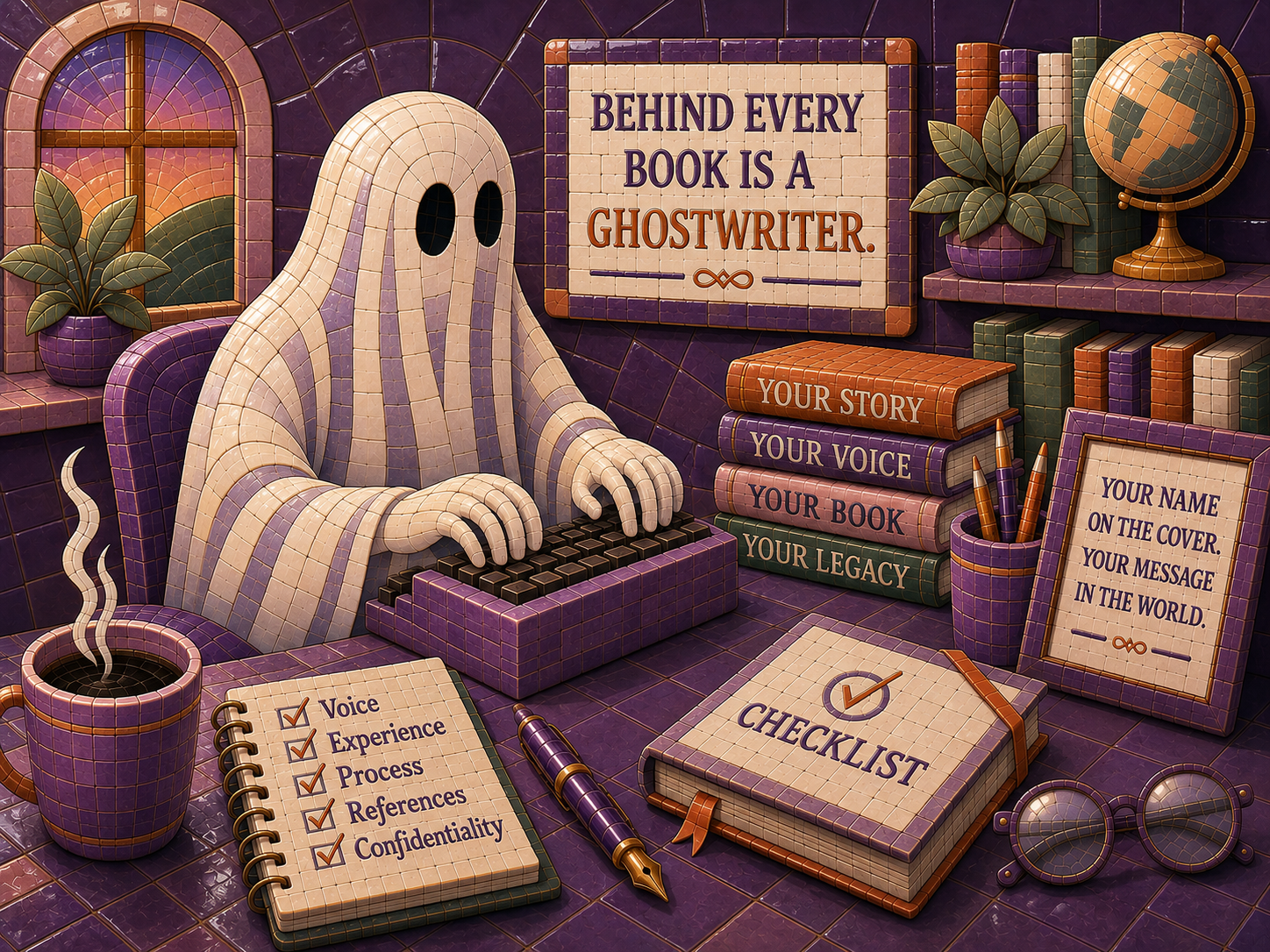
"Ghostwriter" is one of those job titles people assume they understand until the moment they need to hire one. I'm reminded of the many times, upon meeting someone new, that I'm asked the inevitable, chit-chat question:
"What do you do for a living?"
"I'm a ghostwriter."
...cue the puzzled crickets...and then...
"Oh."
There have been a non-zero number of occasions when my interlocutor assumed I was saying I wrote ghost stories and then proceeded to regale me with anecdotes of every creepy experience they'd ever had, presumably to offer material for my next volume of horror fiction.
So, yeah...what does a ghostwriter do?
The short version: a ghostwriter writes your book, in your voice, and your name goes on the cover. The longer version (what that actually involves, and just as importantly what it does not) is worth five minutes of your time before you sign anything.
What does a ghostwriter actually do?
A ghostwriter writes a book, article, or speech on your behalf, in your voice, with you credited as the author. You supply the ideas, the experience, and the point of view. The ghostwriter supplies the structure, the prose, and the discipline of actually finishing. The result is your book, not the ghostwriter's interpretation of you.
In practice, that means hours of recorded interviews, a detailed outline you approve before a single chapter is drafted, and successive drafts shaped around your reactions. My ghostwriting projects are built on that rhythm: I ask, you talk, I write, you correct me. The book becomes more and more true with every pass.
Where does the material come from if I'm not writing it?
Everything on the page comes from you, and only from you. A ghostwriter draws on structured interviews, your notes and emails, past talks, podcast appearances, and anything else you've already said or written. Nothing is invented.
A good ghostwriter is closer to a portrait painter than a novelist: every element is composed, but the subject is entirely real. This is why the interview process matters more than most clients expect. The questions are designed to surface the stories you have stopped noticing because you have lived with them for so long. The insight gleaned from these exchanges are invaluable.
Why does your name go on the cover and not the ghostwriter's?
Because the book is yours. Ghostwriting is work for hire: you own the copyright, the royalties, and the credit, and the ghostwriter is paid for the craft, not the byline. The ideas and authority on the page were yours before we ever spoke. The ghostwriter gave them shape, not substance.
Most professional ghostwriters, myself included, work under confidentiality agreements as a matter of course. Whether you ever mention the ghostwriter's involvement is entirely your decision. Just know that I won't.
What does a ghostwriter NOT do?
A ghostwriter does not invent your expertise, guarantee a bestseller, or replace your involvement. The author's job doesn't disappear. It changes shape. Specifically, a ghostwriter will not:
- Fabricate credentials or stories. If it didn't happen, it doesn't go in the book.
- Promise sales numbers. Anyone who guarantees a bestseller is selling something other than writing.
- Publish or market the book. Those are separate disciplines that come after the manuscript.
- Work without you. No interviews, no book. Your time investment is real, just dramatically smaller than writing it yourself.
If someone offers you a finished book with none of your involvement, what you are being offered is generic content with your name stamped on it. That's a different product with a different value.
Is ghostwriting ethical?
Yes. Ghostwriting has been a legitimate professional practice since Ancient Greece, used by presidents, executives, celebrities, academics, and first-time authors alike. The premise is simple: you have something worth saying, and a professional writer has the craft to say it well. That's a fair exchange.
The ethical obligation is that the ideas and authority on the page are genuinely yours, which, in interview-driven ghostwriting, they are. What the ghostwriter contributes is craft, not content.
How do I know if ghostwriting is right for my book?
If you have expertise, a story, or a message worth a book, but not the time, the inclination, or the confidence to write it yourself, ghostwriting was designed for exactly your situation. The question is not whether it's right in principle. The question is whether the match between author and writer is right for your specific project.
A good starting point is a scoping conversation to define the book, the reader, and the timeline. If what comes back sounds like you on your best day, you're in the right room.
Frequently asked questions
Is it legal to publish a book written by a ghostwriter?
Yes, entirely. Ghostwriting is a standard industry practice with no legal restrictions. You own the copyright under a work-for-hire agreement, and there is no disclosure requirement for commercially published books.
How long does working with a ghostwriter take?
A business or nonfiction book typically takes four to nine months from first conversation to finished manuscript when working with a ghostwriter. Memoir and narrative work often runs longer. The biggest variable is how quickly the author can sit for interviews and review drafts.
Will people know I used a ghostwriter?
Only if you tell them. Professional ghostwriters work under confidentiality agreements and do not discuss clients. The finished book carries your name and, in every meaningful sense, your voice and ideas, because that is where they came from.
Can a ghostwriter write in my existing voice?
Yes, that's the core of the job. An experienced ghostwriter builds your voice profile through interviews, samples of your writing and speaking, and iterative drafts. The goal is a manuscript that sounds like you on your best day, not like the writer performing a version of you.
What if I want to write some of the book myself?
That's called a collaborative writing arrangement, and it works well when the division of labor is clear from the start. Some authors write the parts they enjoy (an opening chapter, a key section), and the ghostwriter handles the rest. The contract and process simply need to reflect that.