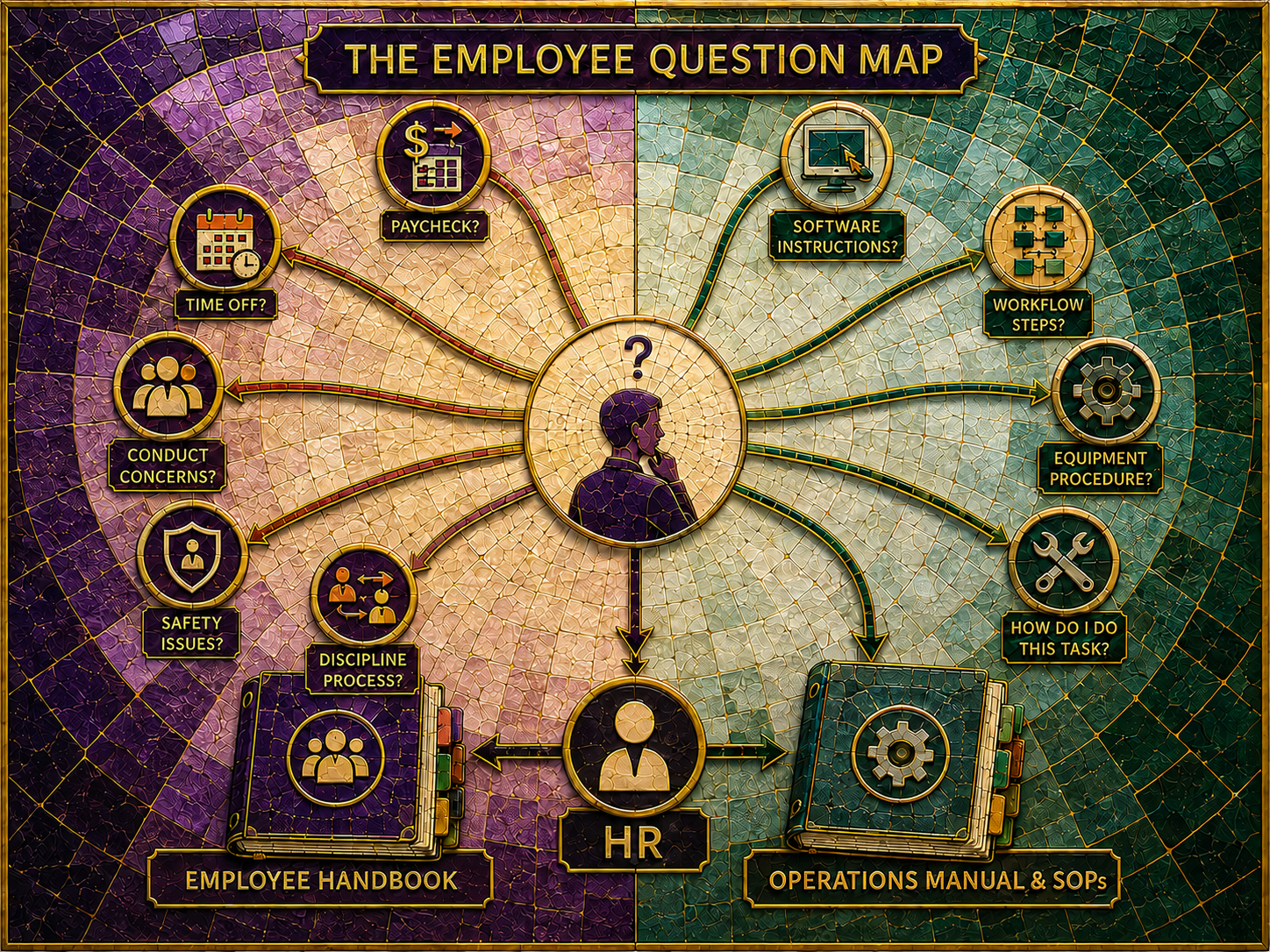
An employee handbook is one of the few documents a person reads on their first day and never opens again. That is not entirely the reader's fault. Most handbooks are assembled from a template, a few paragraphs of borrowed legal language, and whatever the last dispute made someone want in writing, which produces a document that protects the company on paper and tells a new hire almost nothing useful.
What is an employee handbook actually for?
An employee handbook sets the terms of the working relationship: what the company commits to, what it expects in return, and what happens when either side falls short. It is a document about employment, not about the work itself. Nearly every bloated handbook I have read failed on that distinction.
When I sat on the finance side of a manufacturing company, our handbook covered pay periods, attendance, safety obligations, and discipline. It never explained how to run a line, and that was deliberate. The moment a handbook starts teaching a task, it has taken a job that belongs to a procedure, and procedures change every quarter while a handbook should hold steady for a year or more. Mixing the two guarantees that one of them is always wrong.
What belongs in an employee handbook?
Terms, conduct, and entitlements. Nothing that varies by job title. If an employee would raise the question with HR rather than with their supervisor, it belongs in the handbook.
- Pay periods, classification, overtime rules, and timekeeping
- Time off: vacation, sick leave, holidays, and leave of absence
- Conduct standards, harassment and discrimination policy, and the reporting path
- Safety obligations and what to do after an incident
- The discipline process and how employment ends
- An acknowledgment page the employee signs and dates
One caution I give every client. A handbook is a legal instrument in a way a standard operating procedure is not, so have an employment attorney read it before it circulates. My work is making it accurate, consistent, and possible to follow. Whether a clause holds up is a question for counsel, and the two reviews are not interchangeable.
What does not belong in an employee handbook?
Anything that explains how to do a job, and anything that changes more than once a year. Software instructions, department workflows, approval chains, and equipment steps all belong in your procedures and your operations manual, where they can be revised without reissuing the handbook to every employee.
The second category is harder to talk clients out of: the warm, unenforceable sentence. Statements about treating everyone like family, or always promoting from within, read well in a draft and get quoted back during a dispute. A handbook is not the place to describe the culture you hope to have. Describe what you will actually do, and let the culture show up in how people are managed.
Why does nobody read it after the first week?
Because it is handed over all at once on the day a new hire has the least capacity to take anything in. Day one already carries names, badges, systems, and a tour. A forty-page policy document dropped into that hour is not being read, it is being signed.
Working memory is narrow under pressure, and a first day is nothing but pressure. The signature confirms receipt, not comprehension, and treating it as comprehension is how companies end up surprised that nobody knew the leave policy. The practical fix is to point a new hire at the four sections that matter in week one, which are pay, time off, safety, and who to call when something goes wrong, then let the rest sit as reference until it is needed.
How should an employee handbook be organized?
In the order an employee's questions arrive, not the order the policies were written. Pay and time off come first because those are the sections people return to. Discipline and separation belong further back, since a reader who needs them is rarely browsing.
Headings should be phrased the way an employee would ask, so "How to request time off" rather than "Section 4.2, Paid Leave Administration." Keep every section the same internal shape, so a reader learns the pattern once. This is the part clients usually underestimate, and it is ordinary technical writing work: same content, arranged so it can be found.
Where does the handbook end and policy documentation begin?
The handbook states the rule. The policy document holds the detail behind it. The handbook says leave is available, who approves it, and how much notice you owe. The leave policy carries the eligibility tables, the forms, the accrual math, and the exceptions.
Splitting them keeps the handbook short enough to stay readable and stable enough to stay accurate. When the accrual formula changes, you revise one policy document rather than reissuing a signed handbook to every employee on the payroll. If your current handbook has already swallowed all of that detail, pulling the two apart is usually editing work rather than a rewrite.
Who owns it, and how often should it change?
One named owner, one scheduled annual review, and a revision date on the cover. A handbook with no owner drifts quietly out of date, and an undated handbook is difficult to rely on when someone asks which version they agreed to.
Substantive changes deserve a fresh acknowledgment rather than a quiet file swap, both because it is fair and because it is the only way to know what each employee actually consented to. Common questions are answered on the FAQ, and a discovery call is the fastest way to work out whether your handbook needs rewriting, reorganizing, or dividing into the handbook and the policy set it was always trying to be.
Frequently asked questions
What should be included in an employee handbook?
Terms of employment and conduct, not job instructions. That means pay periods and classification, timekeeping, time off and leave, conduct standards including harassment and discrimination policy with a reporting path, safety obligations, the discipline and separation process, and a signed acknowledgment page. A useful test is whether an employee would take the question to HR rather than to their supervisor.
What should not go in an employee handbook?
Anything that explains how to do a specific job, and anything that changes more than once a year. Software steps, department workflows, and equipment procedures belong in standard operating procedures and the operations manual. Also avoid warm but unenforceable promises about culture or advancement, since those get quoted back during a dispute.
What is the difference between an employee handbook and a policy document?
The handbook states the rule and the policy document holds the detail behind it. The handbook says leave is available, who approves it, and how much notice is required. The leave policy carries eligibility tables, forms, accrual calculations, and exceptions. Keeping them separate means a formula change does not require reissuing a signed handbook to every employee.
How often should an employee handbook be updated?
Review it once a year on a scheduled date, with one named owner responsible for it and a revision date printed on the cover. Substantive changes should go out with a fresh acknowledgment rather than a quiet file replacement, so there is a clear record of which version each employee agreed to.