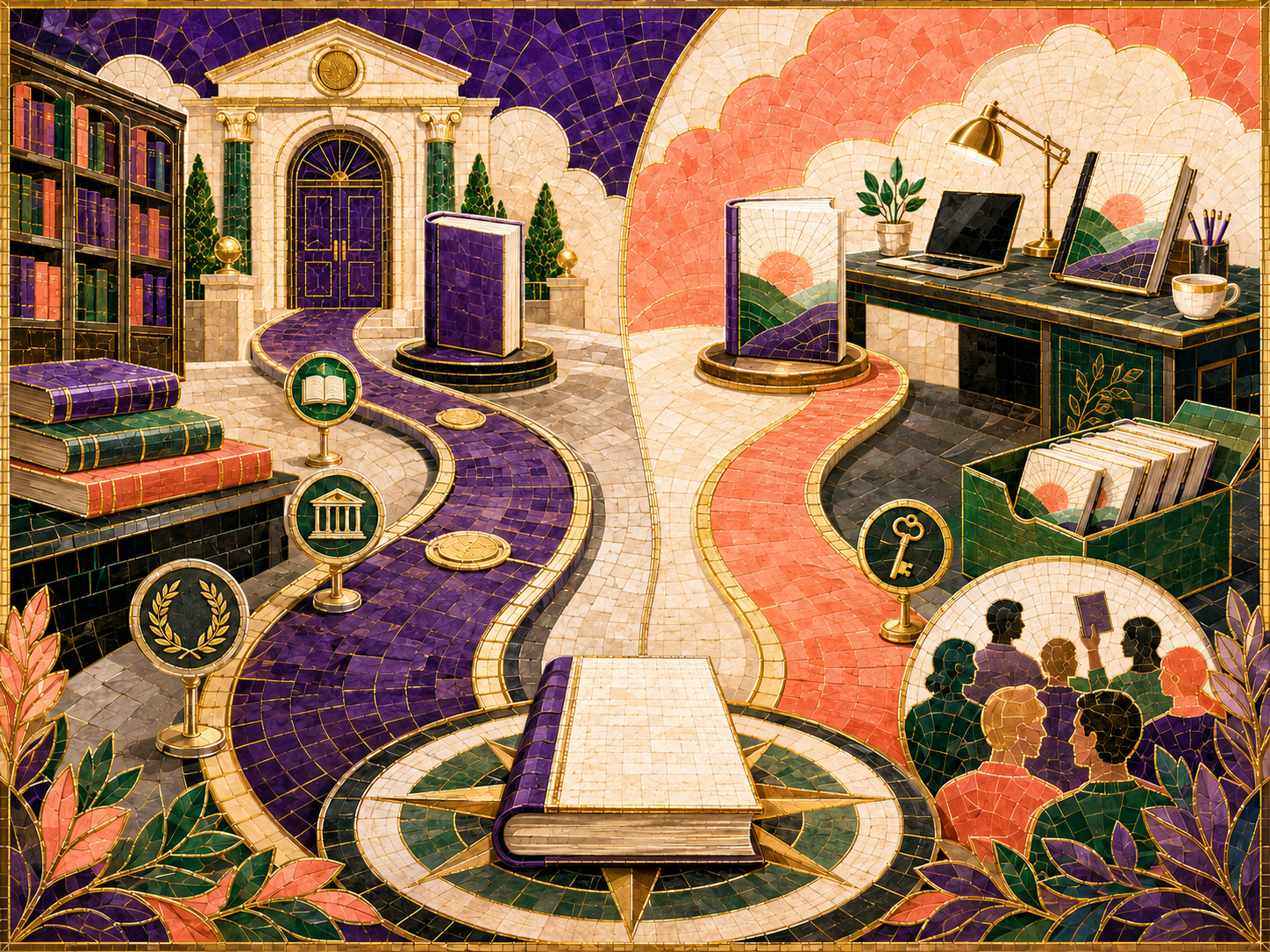
Every author I work with eventually asks the same question, usually somewhere around the third chapter: should I self-publish this book, or pursue a traditional deal? It's the right question to ask, and the honest answer depends far less on prestige than on what you want the book to accomplish. Here's how the two paths actually compare, from someone who has prepared manuscripts for both.
What is the difference between self-publishing and traditional publishing?
In traditional publishing, a publishing house acquires the rights to your book, pays you an advance, and covers the cost of editing, design, printing, and distribution. In self-publishing, you keep all rights and all creative control, fund production yourself, and earn a much larger share of every sale. That single structural difference (who owns the rights and who pays the bills) drives everything else.
Traditional publishing is a licensing arrangement: the publisher invests in your book because it expects a return. Self-publishing is entrepreneurship: you are the publisher, and the book is your product. Neither model is inherently more legitimate. Some of the most successful books of the past decade have come from each.
What does traditional publishing offer that self-publishing cannot?
Traditional publishing offers institutional validation, physical bookstore distribution, a professional team you do not have to assemble, and an advance paid to you rather than costs paid by you. For certain goals, those advantages are decisive.
A deal with a recognized house still carries weight with media, literary prize committees, and corporate audiences. National print distribution (actual copies on actual shelves) remains nearly impossible to achieve alone, and the advance, whatever its size, means the publisher bears the financial risk.
The trade is control and time. Expect eighteen months to two years from signed contract to publication, a title and cover you may not choose, and royalties of roughly 10 to 15 percent of the list price on hardcovers, less on paperbacks.
What does self-publishing offer that traditional publishing cannot?
Self-publishing offers complete ownership, speed to market, direct control of pricing and content, and royalties of roughly 35 to 70 percent of the sale price depending on platform and format. You answer to no acquisitions committee and no publication calendar but your own.
A finished manuscript can be a published book within weeks. You keep the rights forever, which matters if you plan audiobooks, translations, or a revised edition. For business authors, the book often functions as a credential and a client-development tool, and speed plus control usually serve that purpose better than a publisher's schedule.
The trade runs the other direction: you fund and manage everything. A professionally self-published book requires real editing, real cover design, and real interior formatting, and skipping those steps shows.
Which path pays more?
Per copy, self-publishing pays several times more. Per book, it depends entirely on sales. A traditional deal pays an advance (commonly in the four or five figures for a first nonfiction book) against modest royalties. A self-published author keeps most of each sale but starts at zero and shoulders the production costs.
Most books, on either path, sell fewer copies than their authors hope. The financial question is really a risk question: an advance is guaranteed money, while self-publishing income is earned one reader at a time. Authors with an existing audience tend to do better in self-publishing than the averages suggest.
How do you get a traditional deal?
For nonfiction, you sell a book proposal (an argument for the book and for you as its author) through a literary agent, usually before the manuscript is finished. For fiction and most memoir, you query agents with a completed manuscript. Publishers rarely accept unagented submissions.
Your platform, meaning the audience already listening to you, weighs heavily in nonfiction acquisitions, sometimes more than the writing itself. That's not cynicism; it's arithmetic. A publisher is buying reach as much as prose. If you are weighing this route, the proposal deserves as much craft as the book.
How do you decide which is right for your book?
Choose the path that matches the job the book is doing. A few questions I ask every author:
- Is your timeline measured in months or in years?
- Do you want the book in airport bookstores, or in front of a specific audience you can reach directly?
- Is the book itself the product, or is it a door-opener for your business?
- How much control over title, cover, and content are you willing to give up?
- Would a modest advance matter more to you than long-term rights?
Speed, control, and a business purpose point toward self-publishing. Bookstore presence, institutional credibility, and a publisher's team point toward traditional. That said, the paths are not permanently exclusive; strong self-published sales have led to traditional deals more than once.
Either way, the manuscript comes first, and it has to be good. That's where I spend my days. If you're still deciding, my ghostwriting page explains how I help authors get from idea to finished manuscript, the FAQ answers the questions I hear most, and a discovery call is the fastest way to talk through your specific book.
Frequently asked questions
Do you need a literary agent to be traditionally published?
For nearly all major publishing houses, yes. Publishers rarely accept unagented submissions, so finding an agent is effectively the first step of traditional publishing. Some small and university presses do accept direct submissions from authors.
Can a self-published book later be picked up by a traditional publisher?
Yes. When a self-published book sells well or builds a strong audience, traditional publishers do acquire them. It isn't the most common route, but strong sales numbers are persuasive evidence for an acquisitions team.
How much does it cost to self-publish a book professionally?
Most professionally self-published nonfiction books cost several thousand dollars in total, covering editing, cover design, and interior formatting. Costs vary widely with the length of the manuscript and the level of editing it needs.
Is self-publishing considered less credible than traditional publishing?
Far less than it used to be. Readers largely judge a book by its quality, not its imprint. A professionally edited and designed self-published book is credible in nearly every business context, though traditional publishing still carries more weight with media and literary prizes.