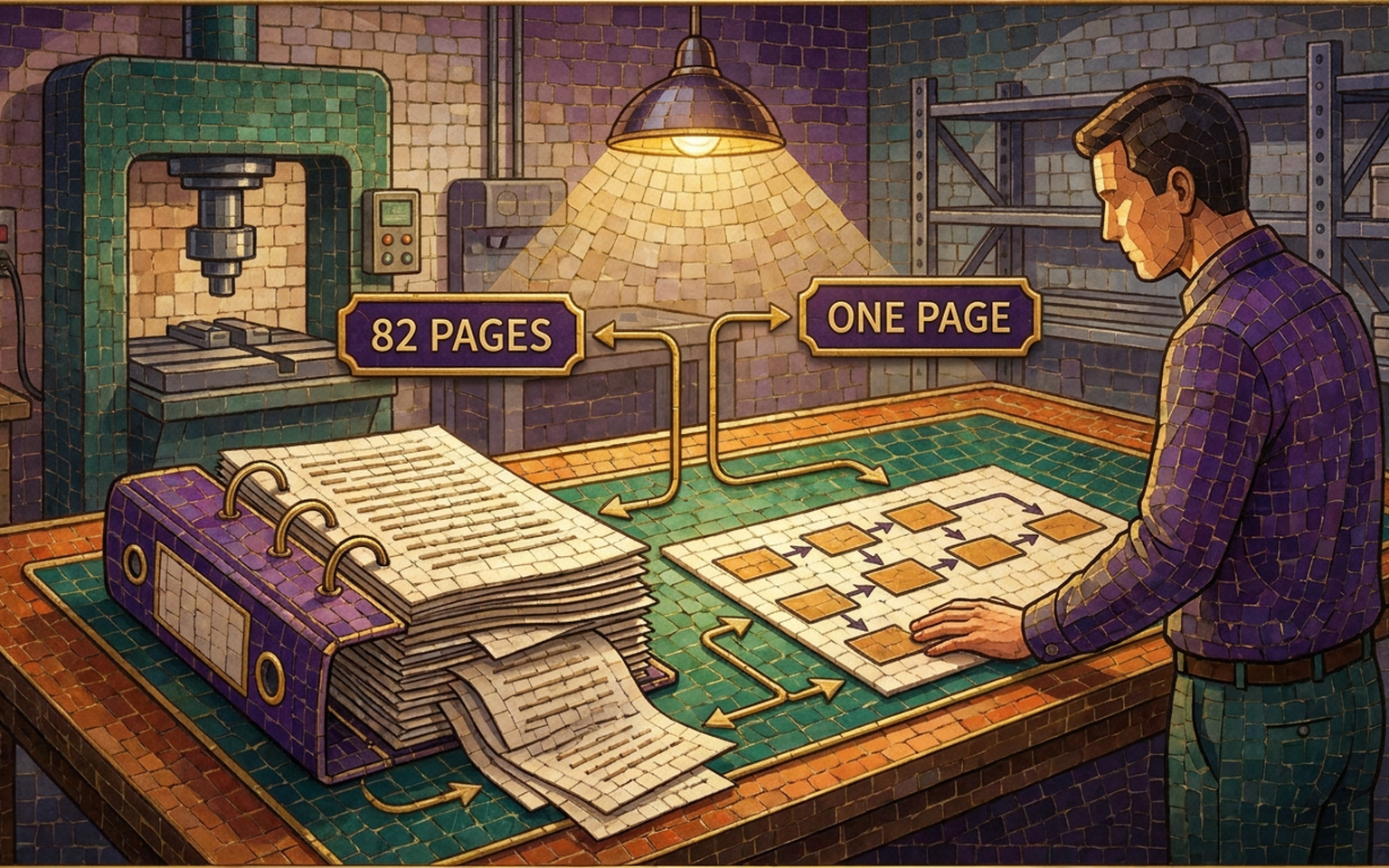
The quality manual I inherited at a manufacturing company ran eighty-two pages and told me almost nothing about the company. It was the standard with "shall" changed to "we," bound and tabbed, signed by someone who'd already left. Our registrar read about six of those pages, and every one of the six described us rather than a clause.
Does ISO 9001 still require a quality manual?
No. The 2015 revision removed the mandatory quality manual along with the six mandatory procedures the 2008 edition required. Companies keep writing one anyway, and the reason is sound. Customers ask for it during supplier approval, auditors open with it, and whoever inherits quality next needs a single document that shows how the pieces connect.
What changed is the reason for writing it. Under the old edition the manual existed because the standard said so, which is why so many of them read like homework turned in on time. Now nothing compels it, so the only defensible reason to write one is that a specific person needs it.
Those people are identifiable. A customer's supplier quality engineer filling out an approval packet. The person who takes over quality when your current manager retires. An auditor deciding in the first hour whether this system is real or decorative. Write for those three and the document takes a different shape than it does when you write for a clause list. What the standard actually requires you to document is a much shorter list than most companies carry, and the manual isn't on it.
Why do most quality manuals read like a copy of the standard?
Because they're built from a template that walks the clauses in order, and the quickest way to fill a clause-shaped hole is to restate the clause. The result survives a surface check and describes no particular company. An auditor can tell inside two pages, and so can anyone in your building who opens it to answer a real question.
The template isn't the problem by itself. The problem is what happens when the person filling it in doesn't know the operation. A consultant who has been in your plant for two days can restate a clause accurately and still not know that your second shift runs a different inspection sequence than your first, or that the sales office commits to delivery dates the floor hears about on Friday afternoon.
The failure I watched came straight out of that gap. Our manual said finished product was released by the quality manager. In practice, on nights and weekends, the shift lead released it and the quality manager reviewed the paperwork the next morning. Both arrangements were defensible. Only one of them was written down, and it wasn't the one that happened. The auditor found it in ten minutes by asking a shift lead what he did when a job finished at 2 a.m., and a manual written to be safe produced a nonconformance.
That's the cost of the copied manual, and it isn't theoretical. A document that describes an imaginary company gives the auditor something to compare reality against, and reality loses.
What belongs in a quality manual that describes your actual company?
Scope, and what you excluded with the reason why. Context: what you make, who buys it, which regulations bite. A map of your processes and how they hand off to each other. Who owns what, by role rather than by name. Then pointers to the procedures and records that carry the detail, instead of the detail itself.
The process map earns the document. Everything else can be assembled from paperwork you already have. The map has to come from how work actually moves, which means walking it, and that walk is where a company finds out that two departments each assume the other owns incoming inspection.
Ours ended up as a single page. Nine boxes: quote, order entry, purchasing, receiving and incoming inspection, production, in-process inspection, final inspection and release, shipping, and the corrective action loop feeding back into all of them. Under each box, the role that owned it and the two or three documents that governed it. An auditor could start anywhere on that page and trace a job through the building. A new hire could see the whole company in ninety seconds. The eighty-two-page version contained no such page.
The exclusions paragraph deserves more attention than it usually gets. If you don't design product, say so plainly and say why: we manufacture to customer-supplied drawings and specifications and perform no design activity. One sentence closes the clause honestly. A vague exclusion, or a silent one, invites an auditor to go looking for the thing you didn't want to discuss. Mapping the process before you write about it is what keeps both the map and the exclusions true.
How long should a quality manual be?
Fifteen to twenty-five pages covers most small and mid-sized manufacturers, though the ratio matters more than the count. If more than a quarter of the document restates the standard, it's too long at any length. Every page should hold something an auditor couldn't have known before reading it.
Length is a symptom. Those eighty-two pages weren't eighty-two pages of information. They were roughly eleven pages of company wrapped in seventy pages of somebody else's document, and the eleven were hard to find.
The objection I hear from skeptical buyers is fair: a thin manual looks unserious, and a customer's supplier approval team scores it against a checklist that rewards bulk. That happens. Supplier questionnaires do ask whether you address each element, and a lean document can read as a gap to someone scanning for headings.
The answer isn't padding. It's a one-page cross-reference at the front that maps each clause of the standard to the place in your system that satisfies it: a named procedure, a form, a record, a role. Reviewers get the completeness they're checking for, auditors get a route into your system, and you don't write seventy pages about a document they already own a copy of.
What do you do with a manual that's already a copy of the standard?
Don't start over. Print it and mark every sentence that could only be true of your company. In most manuals that's ten to fifteen pages of real content buried in restatement. Keep those, add the process map and the ownership table, cut the rest, and route the detail down to the procedures where it belongs.
Marking took me an afternoon. Rewriting what survived took four days, and most of those four days went to interviews rather than writing, because half the sentences I'd kept turned out to describe the company as it had been three years earlier. That's the ordinary condition of an old manual. It isn't wrong so much as expired.
One caution for anyone doing this. Don't delete a clause reference just because the sentence around it was empty, or you'll lose track of where the requirement is met now. Note the new location as you cut. And put the rewritten manual under the same version control, owner, and effective date that you apply to everything else, because an uncontrolled quality manual is a strange thing to hand an auditor whose subject is control. If you're wondering how the rest of the system will hold up under the same scrutiny, the audit-readiness question is the next one to ask.
Is it worth paying someone to write it?
A writer earns the fee when the people who know the operation can't get it onto a page, when the quality manager is also running production, or when a customer audit is close and the current manual describes a company you stopped being. What a writer can't do is decide how your processes should work. That decision stays inside the building.
When I write one, the first two days are walking and interviewing rather than drafting. I follow a job from order to shipment, ask each owner what they actually do, and write down the differences between that and what the current document claims. The manual comes out of those notes. Clients are often surprised that the writing is the short part.
Rates vary with how much of the map already exists, from a few thousand dollars to rewrite a manual around a documented system, to noticeably more where the processes have never been drawn at all. I quote after a discovery call, once I've seen what you have. The technical writing page explains how I scope that work, the FAQ answers the questions that come up before we talk, and you can book a discovery call whenever you're ready. Bring the eighty-two-page version. There's usually a good eleven pages in it.
Frequently asked questions
Is a quality manual required by ISO 9001:2015?
No. The 2015 revision removed the mandatory quality manual and the six mandatory procedures required by the 2008 edition. Most companies still write one because customers request it during supplier approval, auditors use it as an entry point, and a new quality manager needs one document showing how the system fits together.
What should a quality manual contain?
The scope of the quality management system and any exclusions with the reason for each, the context of the organization, a map of the processes and how they hand off to one another, the roles that own each process, and references to the procedures and records that carry the detail. The detail itself belongs in those procedures, not in the manual.
How long should a quality manual be?
Fifteen to twenty-five pages suits most small and mid-sized manufacturers. The more useful test is the ratio: if more than a quarter of the document restates the standard rather than describing the company, it is too long at any page count.
How do you fix a quality manual that just repeats the standard?
Do not start over. Print it and mark every sentence that could only be true of your company, which is usually ten to fifteen pages. Keep that material, add a one-page process map and an ownership table, cut the restatement, and move the detail into the procedures. Note where each cut requirement is now met, and place the rewritten manual under normal version control.