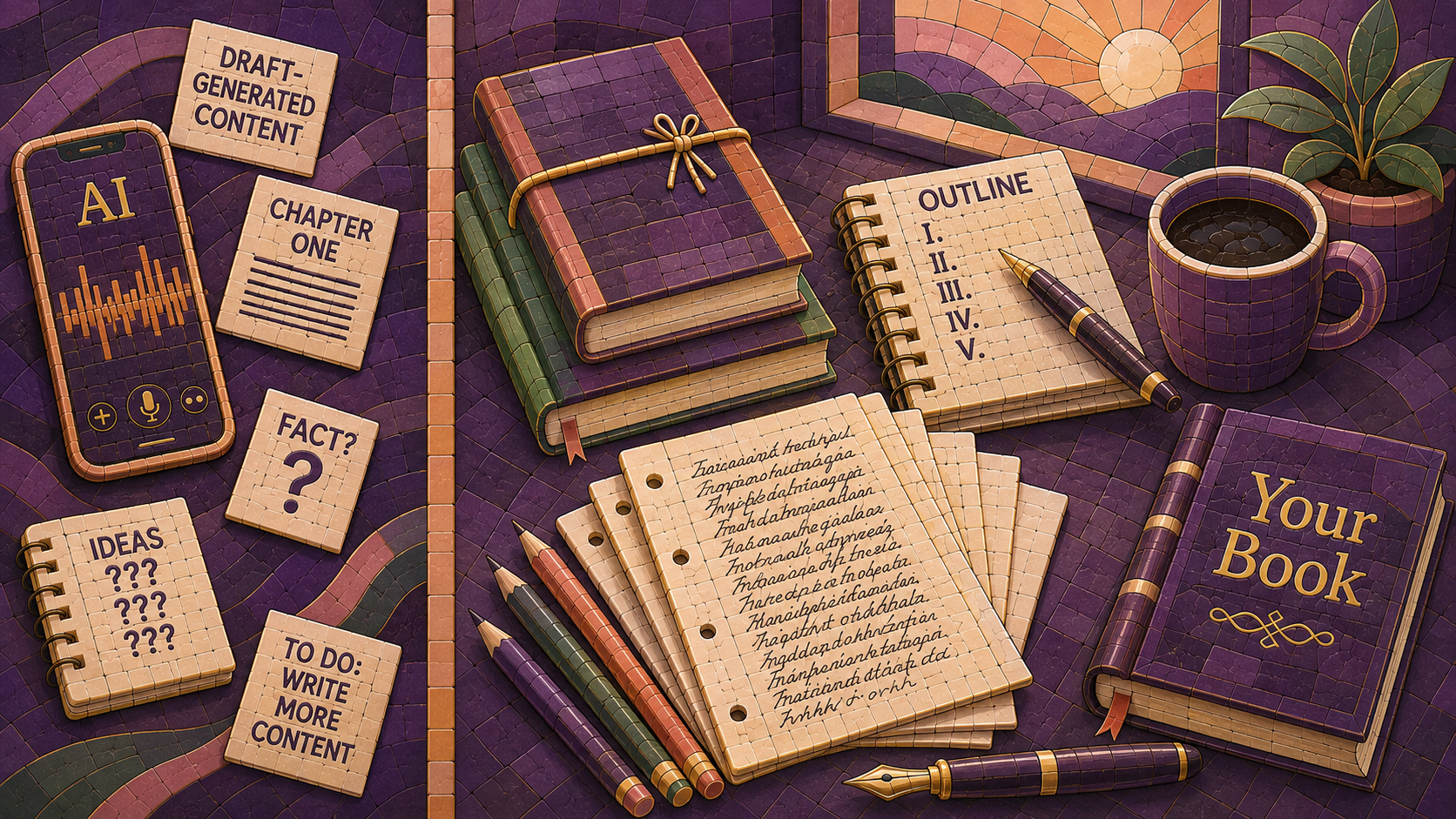
AI can produce a draft, but it cannot author your book. Every author considering a ghostwriter now also wonders the obvious thing: could I just use AI? It's a fair question, and the honest answer is more interesting than the marketing on either side. AI has changed what is possible, but it hasn't changed what a book with your name on it actually requires.
Can AI write your book?
AI can generate grammatical pages on almost any topic in seconds, but a draft is raw material, not a finished book, and the gap between the two is where all the hard work lives. AI gives you words on a page. What it doesn't do is provide the judgment to determine which words to use, in what order, and what to leave out. It can't provide insight, and it can't listen.
What actually happens when you write a book with AI?
You get speed and fluency, and you inherit three problems: the voice flattens toward a generic middle, the facts are unreliable and confidently wrong, and the narrative has no spine. AI writes the average of everything it has read, which is exactly what a book in your distinct voice cannot be.
The first draft feels productive. The revision, where you try to make it yours and true, is where the time goes. In practice, the recurring failures look like:
- Sameness. It reads competent and forgettable, the texture of a hundred thousand other pages.
- Invention. It fabricates quotes, sources, and details without flagging them, which, depending on the subject matter, could be embarrassing at best.
- No through-line. It can fill a chapter but cannot decide why the chapter exists or how it connects to everything else.
- No memory of you. It does not know the story you have never told anyone, because you have to be drawn out, not prompted.
What does a ghostwriter do that AI can't?
A ghostwriter does four things AI cannot: interviews you to surface material no prompt would reach, makes thousands of small judgment calls about voice and structure, fact-checks and stands behind the result, and keeps the whole thing confidential.
The interview is the part people underestimate. Your best material is usually the thing you would never think to write down: the aside, the failure, the casual anecdote, the moment you talk past. A skilled ghostwriter hears it and builds the book around it. See how that works in ghostwriting.
Is your book safe inside an AI tool?
Often, no, at least not by default. Text you paste into many public AI tools can be retained and, depending on the service, used to train future models. For a private memoir, an unannounced business book, or anything under NDA, that is a real exposure.
A ghostwriter works under a confidentiality agreement; a free chatbot works under a terms-of-service page most people never read. Confidentiality isn't a small thing in this work. The whole premise of ghostwriting is discretion: your story stays yours, with your name on it.
Where do AI tools actually help?
AI tools are useful as research aides, first-draft seeders for short-form content, and brainstorming partners, not as book authors. A skilled ghostwriter may use them as one tool among many, the same way a reporter might use a transcription service.
Where they break down is anywhere the work requires sustained voice, factual reliability, emotional intelligence, or the kind of judgment that comes from actually listening to a person over time. That list covers most of what a book needs.
Should you use AI and a ghostwriter together?
The best answer is: let the ghostwriter decide. A professional who knows their tools will incorporate AI where it saves time without compromising quality, and skip it where it would add revision burden. What you shouldn't do is use AI to produce a full draft and then ask a ghostwriter to polish it. That's almost always harder than starting fresh, and a good ghostwriter will tell you so.
Frequently asked questions
Will AI tools replace ghostwriters?
For commodity content (generic articles, templated copy, filler), AI has already changed the market. For books that carry an author's name and reputation, the answer is no, not in any meaningful timeframe. The skills a book requires (sustained voice, original judgment, emotional intelligence, factual reliability) are exactly where current AI tools fail most visibly.
Can I use ChatGPT to outline my book and then hire a ghostwriter for the writing?
Yes, and it can work well if you treat the AI outline as a rough starting point rather than a final structure. An experienced ghostwriter will likely reshape it significantly based on your interviews, and that is a feature, not a problem.
Is it ethical to use a ghostwriter?
Yes. Ghostwriting is a professional practice that's been around for a very long time, used by presidents, executives, celebrities, and first-time authors. You supply the ideas, the experience, and the authority; the ghostwriter supplies the craft of turning that into a readable book. The authorship is legitimately yours.
What happens to my data if I use an AI writing tool?
It depends entirely on the service and its current terms. Many public AI tools retain input text for model training by default, unless you opt out, which requires reading the terms and actively changing settings. For anything confidential, the safest policy isn't to paste it into a public AI tool at all.
How do I know if a ghostwriter is using AI on my project?
Ask directly. A professional ghostwriter should be transparent about their process. If AI tools are part of their workflow, they should be able to explain where and how, and what they do to ensure the result is accurate, original, and in your voice.